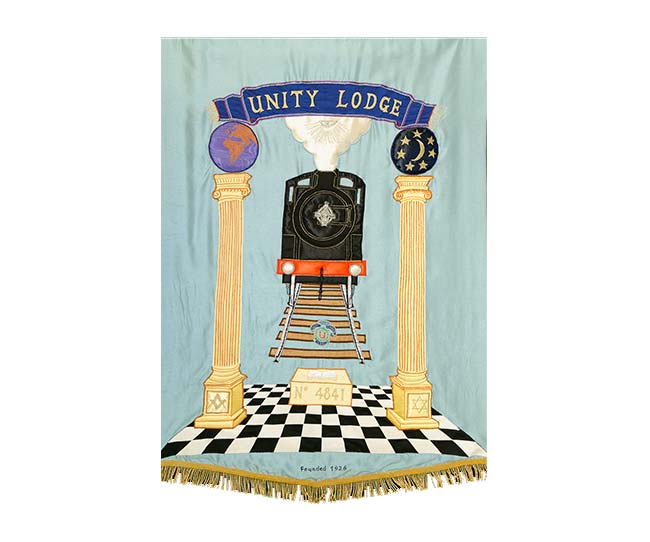
Freemasonry And The Railways
Since the early nineteenth century there has been a close affinity between Freemasonry and the Railway Companies (1, 78). Many eminent railway engineers were Freemasons prominent in the development and history of the railway in this country. Isambard Kingdom Brunel was probably the most famous railway freemason and some of his pioneering engineering with railways, bridges, ships and tunnels are still in daily use around the country. He was born on 9th April 1806 at Portsmouth, Hampshire to a French engineer father who was determined that his only son would follow in his footsteps. At the age of fourteen his father sent him to an institution in Paris for two years to receive the technical education that was unavailable in this country. He was just over five foot tall and wore his trademark eight-inch stove pipe hat to look more imposing. A workaholic with regular twenty hour days whilst smoking more than forty cigars. Brunel built 1,200 miles of railway including Ireland, Italy and Bengal. In the 1850’s his health was failing and died of a stroke on 15th September 1859 aged fifty-three years and buried in Kensal Green Cemetery, London on 20th September 1859. His will left £90,000, which equates to £11 million today. Brunel was initiated into a French lodge on xx 1840 but a Certificate from United Grand Lodge of England granted him access to Lodges in this country.
There were other distinguished masonic railway engineers who were prominent in the development and history of the railways in Derby. Around 1840 the North Midland Railway, Midland Counties Railway and Birmingham & Derby
Railway built workshops to the rear of Derby railway station. The three railways merged in 1844 to form the Midland Railway and the three works were combined to become the Midland Railway Locomotive Works. The Midland Railway had no manufacturing facility and locomotives were designed and built by various private manufacturers with little or no railway operating experience. The first Locomotive & Carriage Superintendent was Matthew Kirtley who persuaded manufacturers to build locomotives to his own design. Kirtley improved the workshops and facilities and in 1847 persuaded the directors that the railway should build its own locomotives. In 1852 a large roundhouse was built followed by a large engine shed with two turntables in 1890. In 1873 the vastly expanded works was separated into the Locomotive Works which remained near the railway station and Derby Carriage & Works located a few miles east at Litchurch Lane. Kirkley died in the same year legacy of locomotive development some of which lasted some eighty years.
George Jackson Churchward was born at Stoke Gabriel, Devon on 31st January1857 and was a renowned locomotive and carriage designer and introduced the first steel-roofed coaches. He worked his way through the ranks, including materials inspector, carriage works manager becoming Chief Mechanical Engineer for the Great Western Railway
from 1902 to 1922. Although long retired and suffering from deafness and blindness he was tragically killed on a misty 19th December 1933 morning by the London Paddington to Fishguard express boat train. Churchward was examining a loose rail joint and was struck by ‘Berkley Castle No. 4085’ locomotive which ironically was a direct descendent of his own design! Churchward first came to public prominence when in 1903 his 4-6-0-wheel arrangement ‘City of Truro’ locomotive was the first to reach a speed of over one hundred miles per hour. He is buried at Christ Church. New Town, Swindon.
William Arthur Stanier was born in Swindon, Wiltshire on 27th May 1876 and was the son of a senior Great Western Railway designer. In 1891 he followed his father into a career with the same railway initially as office boy followed by five years as apprentice in the workshops. In 1904 Churchward appointed Stanier as Assistant to the Divisional Locomotive Superintendent in London. In 1912 he returned to Swindon as Assistant Works Manager being
promoted to Works Manager in 1920. Stanier was recognised as one of this country’s finest locomotive designers and was ‘headhunted’ by Sir Joshua Stamp, Chairman of London & Midland & Scottish Railway. Stanier was appointed Chief Mechanical Engineer on 1st January 1932 and charged with designing modern and more powerful locomotives. He designed many successful locomotives for the railway including the ‘Black 5’ mixed traffic 4-6-0 and the 8F 2-8-0 freight locomotive. During the second world war he was consultant to the Ministry of Supply and retired in 1944. Stanier was knighted on 9th February 1943 and elected a Fellow of the Royal Society on his retirement. President of the Institution Mechanical Engineers in 1944 and Vice President of the Stephenson Locomotive Society until his death. He died in Rickmansworth on 27th September 1965 aged 89 years, but his burial location is unknown.
These Freemasons established the foundations and traditions of the world-renowned railway centre at Derby. This is an important landmark in the history of Unity Lodge which celebrates one hundred years of loyalty to the principles of freemasonry. Brethren over these years have adhered to these principles which has enabled the Lodge to preserve its warrant pure and unsullied. Railway employees sacrificed their lives for King and Country and Unity Lodge members made major and unheralded contributions to successful outcome of two world wars. It is hoped that this brochure will be an inspiration to present and future members of the Lodge so that brotherly Love, Relief and Truth will prevail for future generations.
Early Railway Masonic Lodges
There have been over the years many consecrations of masonic lodges for railwaymen. The history and fortunes of railway lodges have varied enormously but many have retained strong association with the of the railways and freemasonry remains unbroken. There are new railway lodges being consecrated in the present generation as the long association with the railways continues. Some Lodges were associated with a particular railway company whilst others with a depot, works or location.:
Caledonian Lodge No 354 in the Scottish Constitution was founded in 1840 for employees working on the Caledonian Railway. The railway was established in 1845 to connect Glasgow to the English railway network at Carlisle through its liaison with the London & North Eastern Railway. The railway network expanded over the years to cities such as Edinburgh and Aberdeen. The warrant allowed the Lodge to meet on Caledonian Railway property anywhere in Scotland. In later years every non-railwayman admitted to the Lodge had to ride on a live footplate for a few hours in token of qualification! After ten years it ceased to be a travelling lodge and moved to permanent home in Glasgow.
Scientific Lodge No. 840 warrant was granted on 25th October 1860 for engineers and staff working at the extensive London & North Western Railway Works at Wolverton, Buckinghamshire. The Lodge was Consecrated on 15th December 1860 at the National School Room, High Street, Stony, Stratford, Buckinghamshire. Subsequent Lodge meetings were normally held at various hostelries during its early history until 1956 when finally moving to the Masonic Hall, The Square, Wolverton. James McConnell was the Locomotive Superintendent at the works etween1847 and 1862 whose designs included the ‘Bloomer’ 2-2-2-wheel configuration locomotives and the Wolverton Express Goods’ 0-6-0-wheel configuration freight engines. McConnell installed as the first Worshipful Master of the new Lodge. The London & North Western Railway was the largest company incorporated into the London, Midland & Scottish Railway after the Railway Act.
Gooch Lodge No. 1295 warrant was granted on 27th November 1869 for employees working at the Great Western Railway Works at Swindon, Wiltshire. The Lodge was Consecrated on 19th February 1870 at the Masonic Rooms, Queen’s Hotel, Station Road, New Swindon where every Lodge meeting since that date has been held! The Lodge was named after Sir Daniel Gooch who was a protégé of Brunel who in 1865 appointed him Chairman, Great Western Railway. Gooch was an active Freemason and was Deputy Provincial Grand Master for Wiltshire (1853), first master Lansdowne Lodge of Unity No. 626, Calne, Wiltshire 1854 and later Provincial Grand Master of Berkshire & Buckinghamshire.
Onward & Invicta Lodge No. 2912 warrant was granted on 6TH March 1902 for employees of the South Eastern & Chatham Railway which operated extensively over Kent. The railway was a working partnership of two very old companies, namely, the South Eastern Railway and London, Chatham & Dover Railway companies. The terminus was London Blackfriars. The Lodge was Consecrated on 6th May 1902 at the Bridge House Hotel, London Bridge, London. Subsequent Lodge meetings were held at various hostelries until finally moving in 1999 to Freemasons’ Hall, Great Queen Street. London.
Beach Lodge No. 2622 warrant was granted on 4th February 1903 for staff working at the Nine Elms Maintenance Depot of the London & South Western Railway. The Lodge was Consecrated on 3rd June 1903 at the Masonic Hall, Southampton, Hampshire. The Lodge was named after William Wither Bramston Beach who was a long serving Member of Parliament and Deputy Chairman, London & South Western Railway and was Initiated into Apollo University Lodge, Oxford whilst at university. The railway had a staff institute at the depot which incorporated a Lodge room for ceremonies and committee meetings. Beach always preferred travelling by train rather than road but was ironically killed by a hansom cab. The second Worship Master R Lingley was also tragically killed in a shunting accident in the Nine Elms Goods Yard. The Lodge meets in London.
Sowest Lodge No. 3797 warrant was granted on 18th June 1917 for staff working for the London & South Western Railway. Its badge incorporates a compass pointing firmly to the south-west in which direction the company’s railway lines ran from London Waterloo. The trains terminated at Plymouth Friary through Okehampton and over the moors. The London & South Western Railway was incorporated into the new Southern Railway in 1923 and the Lodge became a Southern Railway Staff Lodge.
Euston of Lodge No.4395 warrant was on granted on 1st February 1922 for London & North Western Railway employees working at the Company’s Headquarters on Euston railway station, London. The Lodge was consecrated at the meeting held on 2nd May 1922 at the Imperial Hotel, Russell Square, London. Since 1924 all lodge meetings have been held at Freemasons’ Hall, Great Queen Street. London.
Lodges were later consecrated at other railway towns for staff working for the London, Midland & Scottish Railway including:
Iron Road Lodge No. 4964, Manchester in 1927 for civil engineers.
Crewe Lodge No.5030 in 1928 for locomotive works staff in the town
Rockhaven Lodge No. xxx, Horwich in 1959
Masonic meetings were held in many grand and majestic railway hotels in London and around the country. The Great Eastern Railway Hotel at Liverpool Street Station, London was opened in 1884 with two magnificent masonic temples. The temple in the basement was built and dedicated in 1912 in the Egyptian style as far back as 1901.This magnificent neo-classic designed Temple was truly awe inspiring with two brass pillars surmounted by globes reproducing the #entrance to King Solomon's Temple, a blue and gold domed ceiling bearing a five-pointed star of solid glass prism around which are depicted the signs of the Zodiac signs. This stunning temple remained forgotten and walled off for decades before its rediscovery during a 1990's refurbishment of the now privately owned hotel. Masonic Lodges are no longer held in the Temple now used as a popular backdrop for fashion shows, product launches, wedding receptions and cabaret dinners. The Grecian Temple with an ornate and intricate marble and gold leaf setting is considered one of the finest in London. It is still in use for masonic meetings. The entire hotel is a Grade 11 listed building and the Grecian Temple is classified separately as a Grade 1 structure.
Early Railway Lodge Ceremonies
Freemasonry would probably have not survived or thrived had it not been for the tavern, inn, coffee house and later the club, pub and hotel (23). There was one omission -the common alehouse. This was a mere shop or front room of a lowly dwelling where equally lowly people drank ale to excess. Hence, the alehouse was considered not a suitable place for masons to meet. Inns and taverns provided upstairs accommodation for private meetings in addition to the public areas. Most taverns were no more than ordinary houses with a street frontage of some twenty feet with a similar depth that seriously influenced the development of Lodges. Fifteen members could prove an embarrassment but seven occasionally as low as five even proved the rule rather than the exception. During this period there was little or no effective contact between Lodges throughout the country and these early ceremonies were based on custom and practice and not the written manual used these days. The early Lodge Meetings were held around the tables in the inns and taverns with food and drink being served during the Masonic ceremonies. Lodge Meetings were rather informal gatherings with the properly dressed brethren sitting around a table on which was a candelabra to light the proceedings. Masons in the Lodge wore white gloves and an apron as a compulsory uniform and towards the end of the eighteenth-century white socks were also required. Any Brother wearing any other colour was refused admission! There was also on the table a large bowl of punch for refreshment and snacks were demanded and delivered by the doorkeeper as the evening progressed. The Master was the only member the Lodge to wear a hat and with the gavel invested him with power and authority. Ceremonies were of comparative unimportance and only took a few minutes and the Brethren then settled around the table for the serious Business of the evening — the Lectures. The first duty of the Initiate was to wash away the charcoal or chalk diagram on the floor before retiring to restore himself. In due time the temporary drawing was replaced by a permanent design painted on canvas 'The Floor Cloth' and still later the canvas was framed. The Lectures included such topics as the Symbolism of the Ceremonies, the form and furnishings of the Lodge and the duties of Masons. The Lectures were in catechism form with the Master usually asking the questions. The proceedings were leisurely with the eating of snacks, drinking and smoking and Calling off was frequent with ample time for the drinking of toasts and the singing of songs. Loyal toasts were drunk and usually the whole of the family was toasted such as 'The Ladies' and 'Our Fair Sisters'. Most of the Brethren went home after the bill for the evening’s refreshments had been settled with the landlord and gratuities made to the doorkeeper. The Master would postpone the lodge business should the weather be inclement and instead would command the brethren to gather around the fire for comfort and discussion. The Festive Board is an important part of Freemasonry but it was nearly a hundred years before it became an established practice (24). These 'table' Lodges had complete rituals based on the food items on the table and 'Masonic Fire' is a survivor of this.
A ‘Lodge of Reconciliation’ was established following the union of the 'Antients' and 'Modems' Grand Lodges on St. John's Day 27th December 1813. The ‘Lodge of Reconciliation’ invited Masters, Wardens and representatives from Lodges in London and the Provinces to attend special demonstrations of the agreed Ritual and then instruct their own Lodges. It was forbidden to print the ritual or even produce written manuscripts and consequently the communication of the ritual to the various Lodges relied heavily on the ability and the memory of those attending the demonstrations. The ‘Lodge of Reconciliation’ also visited many Lodges to give instruction in the ceremonies but the Lodge was disbanded in 1816. The Book of Constitutions 1819 laid the duty of Lodges and Lodges of Instruction to follow the authorised version of the Ritual as promulgated by the Lodge of Reconciliation (90). Consequently, there are many variations in today’s Masonic rituals which have the authority of time-honoured usage but which provide interest to the visiting Brethren. There is no record of any Lodge having to forfeit its Warrant having failed to exactly conform to the new- workings. G rand Lodge has never written or printed any Ritual although several have been published and used in Lodges such as 'Stability' and 'Emulation’. Grand Lodge would no doubt assert its authority in any deviation from the essentials of the approved Ritual. After the Union in 1813 all Brethren were simply called Freemasons owing allegiance to one Fraternity and Lodges were renumbered in sequence. A ballot gave the 'Antients' the honour of making their Grand Masters Lodge No. 1 on the combined list and subsequently the 'Antients' took the odd numbers and the 'Moderns' the even numbers. This continued until all pre-1814 'Antient' Lodges had been listed after which the more numerous ‘Modern' Lodges continued to be numbered until a total of six hundred and forty-eight Lodges were registered. Unity Lodge for many years probably used the unauthorised rituals detailed above. Charles S. Snell was Initiated into Unity Lodge on 11th March 1927 and progressed through the offices to become Worshipful Master in1942. He was Preceptor of the Lodge of Instruction from 1958 to 1965 and had a major influence on the Lodge rituals for all three Degrees and the Installation Ceremony. In the Lodge archives there are several hand written notes which state that due to the dilapidated condition of the rituals ’this is a faithful and exact copy of original document held by Worshipful Brother Snell’.
The 19th century was a period of consolidation and expansion for English Freemasonry in which the railways played a major part (116). Inter-city trunk routes were built between 1830 and late 1840's and most mainland railway stations were within a day’s travel of London (13). Six thousand miles of track had been completed by the end of the speculative boom in 1847 which by 1860 had increased to ten thousand miles. The Birmingham & Derby Junction Railway opened on 12th August 1839 running from Derby to London Euston through Burton-on Trent, Tamworth, Hampton and Birmingham with a journey time of over seven hours. This compares with today’s fastest time (now routed through Leicester) of one and a half hours. St. Pancras Station was opened for railway traffic on 1st October 1868 although the hotel was not completed until 1875. Sir John Gay Newton Alleyne, 3rd Baronet was Initiated into Okeover Lodge No. 1324 and joined Beaureper Lodge on 17th June 1880. He was born on 8th September 1820 on the family sugar plantation in Barbados and educated at Harrow School and Bonn University. Although he worked on the sugar plantation in his early years he returned to England in 1852 to join Butterley Iron Works, Ripley, Derbyshire. Sir John served as works manager and chief engineer for twenty-eight years and was responsible for several important patents which facilitated steel rolling processes. The company was rolling the largest masses of iron of any foundry in the country by 1863. Among its most famous buildings was the Barlow Train Shed at St Pancras Station which at the time was the largest single span roof in the world. He married Augusta Isabella the daughter of Sir Henry Fitzherbert, 3rd Baronet and Agnes Beresford on 11th March 1851 at Tissington Hall, Derbyshire after the death of his first wife. The two families were known to each other as both owned sugar and coffee plantations in the West Indies.
The first public telegraph line ran between London and Gosport and was opened in February 1845 with transmission of a speech by Queen Victoria. In 1852 time signals began to be transmitted on a regular basis from the Greenwich Observatory to London Bridge railway station throughout the railway telegraph system (which by 1848 had covered 1,800 miles of the growing railway system) and in due course over the whole country. Local time was based on sunrise and sunset and varied throughout the country since the sun rises and sets later in the west than in the east. Hence, ‘Greenwich Mean Time’ became standard throughout the country eliminating the necessity to adjust timepieces to gain about fifteen minutes in every twenty four hours when travelling west to east to compensate for local time differences and vice versa on the return journey. George Bradshaw published the world's first compilation of railway timetables in Manchester on 19th October 1839. It was entitled 'Bradshaw's Railway Time Tables and Assistant To Railway Travelling’ and included fares, route maps, town plans and sold for sixpence. In 1840 the title changed to ‘Bradshaw’s Railway Companion’ and the price increased to one shilling. A new volume was issued at intervals and from time to time a supplement was also issued to keep this up to date. Bradshaw was a Quaker and considered the convention of giving names to the months of the year as a pagan custom (14). Hence, a typical date in the timetable would be detailed as '10th Month, 25, 1840'. The Midland Railway was incorporated on 10th May 1844 by the amalgamation of the North Midland, Midland Counties and Birmingham & Derby Junction Railways. The initial route chosen by the Midland Railway was through Nottingham and not Derby but the former rejected the offer. Derby was not enthusiastic either because in 1835 only twelve people were present at a public meeting! (118). The entire railways system was financed by privately subscribed stocks and bonds worth some two hundred and forty million pounds by 1850 (13).
First World War And Narrow Gauge Railways
The Duffield Bank Railway was built between 1874 and 1916 by Sir Arthur Percival Heywood in the grounds of his mansion in the village of Duffield in Derbyshire. He was born on 25th December 1849 and grew up in the family home of ‘Dove Leys’ in Denstone, Staffordshire. Denstone is a village between Uttoxeter in East Staffordshire and Ashbourne in Derbyshire. The Heywood was a banking family making its fortune from the trans-Atlantic slavery trade operating out of Liverpool. Sir Thomas Percival Heywood, 2nd Baronet was his father who built All Saints Church, the vicarage and schoolhouse in the village in mid-19th century. ‘Dove Leys‘ overlooked the valley through which the North Staffordshire Railway ran from Rochester to Ashbourne developing Heywood’s passion for the railway from an early age. He was keenly interested in locomotive engineering spending many hours at the railway’s works in Stoke. He went to school at Eton and in 1872 graduated from Trinity College, Cambridge with a master’s degree in Applied Science. The college was close to the Great Eastern Railway which was formed in 1862 by amalgamation of Eastern Counties Railway and Eastern Union Railway. The Eastern Counties Railway had opened Cambridge railway station a mile south of college on 29th July 1845 with the original terminus at Bishopsgate station on the edge of the City of London. Bishopsgate station closed to passenger traffic in 1875 when Liverpool Street station built in 1874 became the terminus for the Great Eastern Railway. Arthur Heywood soon made friends with local railwaymen riding on locomotive footplates. In 1872 he married Margaret Effie who was his cousin and daughter of Reverend George Sumner, Rector Alresford, Hampshire and set up home at ‘Duffield Bank House’ on a hillside overlooking Duffield (see Figure 1). Duffield was a mainline railway station on the Midland Railway running from London St. Pancras to xxx through Burton-on-Trent and Birmingham. Several railway directors also lived in the same village for easy access not only to the railway network but to the railway locomotive and carriage works at Derby . Heywood had a keen in locomotive construction and from a wealthy family and with time on his hands built a narrow gauge railway on his estate. Duffield Bank slopes very steeply upwards and the line zig-zagged up the hill with a gradient one in six in part to a wood at the top. Several narrow gauge railways had been built using rail gauges up to two foot but Heywood decided on a fifteen inch rail gauge and developed purpose built engines and rolling stock to run on the line. A mile length track in the form of a figure eight was built over a seven year with a viaduct, tunnels (one cut through rock), freight cars, passenger coaches, sleeping car with toilet and a diner with cooking compartment. Heywood envisaged that narrow gauge railways could make major contributions to any successful war with the transport of soldiers, ammunition and supplies behind enemy lines. He had railway parties on the estate providing tea and unlimited rides. He was keen on campanology and often joined the bellringers at Duffield St. Alkmunds’ Church where he was a churchwarden and sidesman. Heywood was High Sherriff of Derbyshire in 1899 and President of Derbyshire Royal Infirmary in 1895. His three sons enlisted for active service when World War 1 commenced in 1914 together with many of his staff and donated fifty rifles to the Volunteer Training Corps.
Arthur Heywood inherited the baronetcy on the death of his father and returned to live on the family estate at ‘Dove Leys’ in Denstone. He retained the Duffield Bank estate with the narrow gauge railway kept in working order. Heywood was a regular visitor to the estate spending a few days entertaining guests with free tea and unlimited rides. It was the afternoon of 19th April 1916 during one of these visits that Heywood was taken ill and died later that day. Arthur Heywood was buried at ‘All Saints’ Church’, Denstone on 22nd April 1916 and Duffield Bank Railway was sold shortly afterwards followed quickly by the estate. Most of the rolling stock was acquired by the Ravenglass & Eskdale Railway. A topographic and photographic survey in 2010 showed the track route could be traced although the sleepers and rails have long gone. The route could be identified by existing stone-lined or low-walled edges. Quarrying has removed a long stretch of the track bed together with the site of the viaduct but three tunnels remain intact. All the timber built buildings were dismantled or purchased during the first world war. The sites of a ‘tennis ground‘ station, three road carriage sheds and a short trestle bridge were identified together with an underbridge near the ‘tennis ground’ was largely intact. It was not until the formation of the Royal Engineers Light Railway companies in early 1917 that a whole network of light railways was developed using a two-foot gauge. The light railways transformed the army operational abilities and made a decisive contribution to the successful Allied war effort in which a Founder member of Unity Lodge had a major role.
A Forgotten War Hero
Harold Rudgard was born on 4th September 1884 in Reigate, Surrey and educated at Burton Grammar School and Denstone College both in Staffordshire. He served his apprenticeship at the Midland Railway Locomotive Works, Siddalls Road, Derby spending time in the various locomotive workshops shops and attending evening classes at Derby Technical College. His railway expertise was acquired during four years as assistant to Samuel Waite Johnson, the well-known Midland Railway locomotive superintendent. The Johnson engines were among the most beautiful of all the many lovely designs produced during the latter Victorian years. He was successively appointed district locomotive superintendent at Skipton, Derby and Plaistow after periods on the locomotive footplate and in the drawing office. Brother Harold Rudgard was Initiated into Abbey Lodge No. 624 in Burton-on-Trent and also became a member of Mercia Lodge No.4777 and United Service Lodge of Derbyshire No. 3993 both in Derby. He was one of thirty Founder Members of Unity Lodge No.4841 which was consecrated on 8th October 1926 with membership originally restricted to employees of London, Midland & Scottish Railway. Brother Rudgard was Worshipful Master of Unity Lodge in 1930 but resigned on 9th August 1957 due to ill-health and died suddenly in Bournemouth on 5th March 1958 in his seventy-fourth year.
The Territorial Force was established on 1st April 1908 by amalgamation of the Volunteer Force and the yeomanry. The Volunteer Force was organised into fourteen territorial infantry divisions and the yeomanry organized into fourteen mounted brigades. Territorial Force recruits had to be aged between seventeen and thirty five years and enlisted for four years extended by an obligatory year in times of crisis. All new recruits had to attend a minimum of forty drills in the first year and twenty per year thereafter. All soldiers were required to attend between eight and fifteen days of annual camp. The ‘Imperial Service Obligation’ was introduced in 1910 allowing Territorial’s to volunteer in advance for active service as when and where required. 'The London Gazette' dated 26 July 1912 announced that Harold Rudgard was enlisted on 28th June 1912 as a supernumerary with the rank of Second Lieutenant in the 5th Battalion, The Sherwood Foresters (Nottingham and Derbyshire Regiment). A battalion had a strength of about a thousand soldiers of whom thirty were officers but could enlist officers above its required or regular number who were classified as 'supernumeraries'. The Gazette dated 28th January 1913 stated that on 28th June 1912 'Supernumerary Second Lieutenant Harold Rudgard is absorbed into the establishment' and that dated 16th December 1914 reported promotion to Lieutenant. The Battalion was a unit of the Territorial Force which was the volunteer component of the British Army from 1906 to 1920 when it became the Territorial Army. The Territorial Force included the North Midland Division covering Derbyshire, Leicestershire, Nottinghamshire, Rutland and Staffordshire. It was re-designated in 1915 as the 46th (North Midland) Division and classified as a 1st Line Infantry division that would immediately be mobilised on the outbreak of war.
The assassination of Archduke Ferdinand, heir to the Austro- Hungarian Empire, and his wife Sophie in Sarajevo, Bosnia on 28th June 1914 by Serbian nationalists rapidly escalated into the beginning of World War 1. On 28th July 1914 Austria-Hungary declared war on Serbia and within a week Russia, Belgium, France, Great Britain and Serbia were at war with Austria-Hungary and Germany. The 139th (Sherwood Foresters) Infantry Brigade was immediately mobilised on the outbreak of war and was part of the first Territorial Force Division to land in France on 26th/27th February 1915 where it remained for the remainder of the War suffering severe casualties. Harold Rudgard was Embarkation Officer when the 1st/5th Sherwood Foresters Battalion sailed from Southampton for Le Havre on the 25th September 1915. So expeditiously was the embarking that on reaching Le Havre Harold Rudgard was appointed Divisional Entraining Officer! The 'Scheduled or Reserved Occupations Act' decreed that certain categories were exempt from conscription which included coal miners, doctors, teachers, clergymen and those working in factories manufacturing vital ammunition and equipment for the war effort. Railway workers were also exempt from conscription but Harold Rudgard was amongst 22,941 employees of the Midland Railway who enlisted for military service for King and Country of whom 7,068 were injured and 2,833 were killed.
The Battalion Officers included two members of Beaureper Lodge No. 787 namely Captain G. Brittain Gill (Medical Officer) and Captain Clement Walker (Regimental Sergeant Major). Brother Rudgard was very fortunate to survive the war being first injured at Neuve Chapelle soon after landing in France. This is a small village in the Artois region of France located some twenty miles south of Ypres. Neuve Chapelle was the first offensive battle between 10th to 11th March 1915 in which a British Battalion had fought the enemy in waterlogged trenches. This was also the first battle in which the Royal Air Force Flying Corps had taken aerial photographs which facilitated accurate maps to be drawn which assisted the British Army. Although the battle was short the British casualties were large with some 3,500 killed and 8,500 wounded. Lieutenant Rudgard soon recovered from his injuries and became the 139th Infantry Brigade Officer but in June the same year escaped death at Sanctuary Wood in the Ypres Salient by an incredible incident. Every night one of the machine gun posts under his command was accurately bombarded by the Germans with rifle grenades. This gave the Sherwood Foresters a good opportunity for revolver practice by firing at the grenades as they came over the trenches. One grenade which fell into a trench had its fuse blown off by a revolver bullet thus rendering it a dud. This dud grenade hit Lieutenant Rudgard between the shoulder blades knocking him unconscious and necessitating hospital treatment. Lieutenant Rudgard had also escaped death or serious injury several months earlier when sharing a dugout in the Kemmel Trenches, about six miles south-west of Ypres, with Lieutenant William Lloyd Bemrose. The latter was a sniper and credited with very good 'bags' including a 'Brass Hat' and was mentioned three times in despatches. ‘Rudyard’s Artillery' was initially unsuccessful in bombing the enemy with the only artillery available being 'jam tin' grenades or bombs so named because they were literally made out of jam tins packed with guncotton or dynamite and pieces of scrap metal. A bombing team usually consisted of nine men: a Non-Commissioned Officer, two throwers, two bomb carriers, two bayonet-men to defend the team and two 'spare' men in the event of any casualties. An attack or raid on an enemy trench would be initiated by the bombers racing down the trench and throwing grenades into each dugout on passing. It was only after the ‘Mills’ fragmentation bomb was introduced in May 1915 that 'Rudyard’s Artillery' were able to make effective strikes on the enemy. One night both Lieutenants Bemrose and Rudgard fell into a deep sleep from shear exhaustion but during the night an unextinguished candle fell onto Bemrose's trench coat. This could have been dangerous as the dugout was also a bomb store! Rudgard woke up and seeing the coat well alight hurled himself on Bemrose to extinguish the flames. Bemrose thought he was in the hands of Germans and fought desperately until he eventually realised who was fighting. The argument carried on for years as to whom saved the others life - Rudgard for having extinguished the flames or Bemrose for refraining from strangling a Bosche! However, Lieutenant Rudgard was seriously injured# on 11th July 1915 during fighting in the Ypres Salient and was repatriated to England for medical treatment and recuperation returning to the Battalion in December 1915. The Battalion enjoyed an excellent Christmas in 1915 at Widdebroucq with food provided by the citizens of Derby and District together with local purchases. Lieutenant Rudyard had become acting Deputy Adjutancy Quarter Master General by June 1916 and was responsible for the stocking of the village of Fonquevillers which was on the Allied front line with iron rations in preparation for the town being cut off by enemy shell fire. In July 1916 he was promoted to Captain and took over the Adjutancy and was twice mentioned in despatches. The 5th Battalion spent three weeks in Crecy in November 1916 training in open warfare, assaults on and from trenches, battalion and company drill, etc. However, a very disgruntled deputation headed by the Mayor confronted Captain Rudgard and demanded 10,000 Francs for damages caused by the billeted army. Captain Rudgard using his senior managerial experience working in a diverse railway industry proposed that the meeting should adjourn to the nearest estaminet which happened to be owned by the Mayor! The consumption of large quantities of wine produced a convivial atmosphere in which the damage claim was reduced to 780 Francs to the satisfaction of the befuddled deputation.
During this war the British Army relied heavily on horses and mules to pull light artillery, wagons and ambulance and to carry supplies, food, water and ammunition to the front lines. Some fifty three thousand animals were the backbone of the Army's supply lines at a time when mechanisation was in its infancy. It was not until the formation of the Royal Engineers Light Railway companies in early 1917 that a whole network of light railways were developed using a two-foot gauge. The light railways transformed the operational abilities of the army and made an important contribution to the Allied war effort. Captain Rudyard was promoted to Major at the end of 1916 after fighting in the trenches for twenty months and transferred to the Railway Operating Division (Royal Engineers) which was formed in 1914. This transfer was inevitable and probably long overdue because the Railway Operating Division was under the command of Lieutenant- Colonel Walter Paget who in 1907 had been appointed General Superintendent (probably called Chief Operating Officer today) of the Midland Railway. Lieutenant-Colonel Paget duties included running the Midland Railway locomotive department in Derby in which Harold Rudgard was a highly respected locomotive engineer with many years’ experience running various railway depots as previously discussed. The Railway Operating Division was subdivided in 1916 with each army having its own light railway Major Rudgard became responsible for the 4th Army Light Railway comprising 1348 miles of 2-foot gauge transporting . some 130,000 tons weekly towards the end of the war, The majority of the staff were civilians from the large railway companies such as the Midland Railway. Harold Rudgard was a highly respected Midland Railway locomotive engineer as previously detailed and no doubt enlisted engine drivers/firemen, locomotive and track maintenance engineers who were well-known to him to facilitate the smooth running of the light railways. These light railways ran from the French standard gauge railway marshalling yards which were beyond the range of enemy artillery to the front line itself. The tracks were quickly laid, and repaired when necessary, along roads or over smooth terrain by unskilled labourers and soldiers using prefabricated five metre rail sections. The light railways significantly facilitated the delivery of enormous quantities of food, ammunition and fortification construction materials to the large concentrations of soldiers and artillery at the front lines. The principal light railway networks were built where the fighting was at its most ferocious necessitating rapid transportation of soldiers and ammunition which was around Ypres in the North, and the Somme in the South. The British guns fired 13,000 tons of shell on the first day of the Somme offensive on 1st July 1916 and 23,000 tons at Ypres on 31st July 1917. These light railways also assisted in the transportation of thousands of seriously wounded soldiers to hospitals and convalescence centres. An effective railway together with the facilities to quickly repair either war damaged vehicles or breakdowns and available equipment for re-railing locomotives and wagons was essential to the British war effort. Major Rudgard was superintendent of the light railways for the 4th Army and responsible for the railway repair shops which were originally established some forty miles from Calais in Nord-Pas-De-Calais at La Lacque adjoining Berguette railway station. There were 1,200 light railway engines together with 52,000 wagons and a workforce of 1,500 railway engineers and some 800 Chinese. During the first two years of the war over 250,000 British soldiers had been killed by the autumn of 1916 and as more soldiers were drafted to the front duty the vital supply lines, they manned were being seriously depleted. This manpower shortage could have resulted the war being lost but a distant ally made a major contribution to the war effort providing some 140,000 labourers for the Western Front. This was the secret and forgotten Chinese Army! In 1916 China was still partially ruled by colonial powers although independency had been declared some four years earlier. The Chinese labourers worked in the dangerous war zone providing essential and vital manpower for laying/maintaining roads and light railway lines, digging/maintaining trenches and maintaining continuous supply of ammunition to the front line. However, the aforementioned workshops were close to the front line and threatened by the German advance in 1918 and preparations were made for their destruction. Major Rudgard was in command of the salvage operation with a detachment of twenty five volunteers which in a few days were reinforced by about 120 men from other companies. The salvage was very successful with the whole of the repair equipment, buildings and offices, with the exception of the foundry and garage, being moved to new workshops at Beaurainville (some six miles southeast of Montreuil-sur-Mer) and twenty miles closer to Calais. Sixty locomotives were also salvaged and shipped to England. The new workshops covered some 49 acres called 'La Warren' by the locals whereas the troops were billeted over ten acres in a camp designated 'Beaurepaire'. This was no coincidence since there were several senior Officers in the Battalion who were Beaureper Lodge members! In 1918 the heavy gauge railway track consisted of 2,340 miles with 1,496 engines and in the six months from May to October 1918 carried a weekly average of 400,000 tons. Brother Rudgard was later promoted to Lieutenant-Colonel and from 10th January 1919 until 14th July 1919 became responsible for the main heavy gauge railway depot at Audruicq (located eleven miles southeast of Calais) which repaired carriages, wagons, ambulances and leave trains.
Harold Rudgard returned home in November 1918 to continue his distinguished railway career with the Midland Railway in Derby. His appointments included Assistant Superintendent of Freight Trains, Midland Railway (1919) and in 1923 on grouping of the railways was appointed Assistant Motive Power Superintendent, London, Midland & Scottish Railway. He became Divisional Motive Power Superintendent, Midland Division (1932) and in 1948 joined the Railway Executive as Chief Officer (Motive Power). Harold Rudgard was elected President of the Institution of Locomotive Engineers in 1948. This was a prestigious organisation whose previous presidents included such world-renowned locomotive engineers as Sir Nigel Gresley (1927) (who designed the two most famous steam locomotives in the world namely the London & North Eastern Railway A4 Pacific Class locomotives 'Flying the names and 'Mallard') and William Stanier (1938) (who designed the London, Midland & Scottish 'Duchess Class passenger locomotive considered among the finest ever built.). Brother Rudgard was awarded the 'Order of the British Empire' in recognition of his services to war transport. The London Gazette Supplement dated 11th February 1921 reported Brother Rudgard had been promoted to Lieutenant-Colonel and that dated 1st May 1956 ,’Awarded the Territorial Efficiency Decoration'. Brother Rudgard took an active interest in the Ffestiniog Railway which was a Welsh narrow-gauge railway built in 1836 to transport slate 13 miles from quarries at Blaenau Ffestiniog. He served as Chairman of the Ffestiniog Railway Society from 1955 to 1958. Due to his association with the railway, the society's early committee meetings took place in the Locomotive Superintendent's Office at Euston Station.
Midland Railway First World War Memorials
In the early 20th century the Midland Railway was one of the largest railway companies in the country. Its headquarters were in Derby and was the largest employer in the city. At the outbreak of the First World War some twenty three thousand enlisted to fight for King and Country which was about a third of the company’s workforce. Nearly three thousand of these enlisted railwaymen were killed during the conflict with another seven thousand wounded. The Midland Railway memorial stands in Midland Road, Derby close to the railway station and encroaching onto the Midland Hotel’s garden. The Portland stone memorial designed by Sir Edwin Luty is a ten metre high cenotaph with rounded sides in the centre of a two metre high screen wall. The front of the cenotaph facing Midland Road is inscribed:
To The Brave Of The Midland Railway Who Gave Their Lives In The Great War
The screen wall on each side of the cenotaph has rectangular alcoves into which are inserted bronze plaques embossed with the names of the fallen. The names are in alphabetical order with no details of military rank or service. The memorial was unveiled on 15th December 1921 by Charles Booth, Chairman Midland Railway, and Right Reverend Edwyn Hoskyns, Bishop of Southwell and Nottingham, gave the dedication. The railway did not invite the families of those killed during the war to the ceremony but offered free travel after the unveiling for relatives wishing to view the memorial. The Midland Railway published a Book of Remembrance a copy of which was forwarded to the family of every railwayman listed on the memorial. The book contained a photograph of the memorial together job description within the company of each man, station or depot, regiment and military rank.
The Railway Comes To Derby
The construction of the North Midland between Derby and Leeds was authorized by An Act of Parliament dated 4th July 1836. The engineer was George Stephenson who selected a route through Duffield, Belper, Ambergate and Chesterfield so that nowhere was there a gradient of more than1 in 330. The original route was along the west side of the river Derwent and was opposed by the Strutt’s fearing that the railway construction could affect the #flow of water to their Belper cotton mills. It was also a fact that the railway would have been clearly seen from Bridge Hill House which was the residence of George Benson Strutt! Hence, the railway was re-routed east of the Derwent involving a mile length cutting through the town centre. The railway was opened for traffic on 20th June 1840 and celebrated by a great feast for all railway workers involved in the construction at Duffield. The workers marched four abreast from Ambergate through Belper where another detachment joined and on to Duffield to join
other workers. Trestle tables and forms had already been arranged and each worker was given a 2lb.loaf! There were huge plates of roast beef and many barrels of ale and each man could eat and drink as much as he could. Afterwards there was free ale for allcomers and no doubt jollifications continued until the beer ran out! The North Midland, Midland Counties and Birmingham & Derby Junction Railways were amalgamated on 10th May 1844 to form the Midland Railways.
The Railways Act 1921 was introduced to reduce the financial losses occurred by many of the country’s existing railway companies. There were over a hundred small and large railway companies often in local competition with each other. The Act removed these railways from internal competition whilst retaining some of the benefits derived during the First World War the railways were under state control. This Act enabled the majority of the railway companies to be grouped on 1st January 1923 into four companies, namely, Great Western Railway, London & North Eastern Railway, London, Midland & Scottish Railway and Southern Railway. The London, Midland & Scottish Railway (LMS) was the largest four railway companies to emerge from the grouping of the railways incorporating:
London & North Western Railway (LNWR) 2667 ⅟ miles including Lancashire & Yorkshire Railway(L&YR)
Midland Railway (MR) 2170∕ miles
Caledonian Railway (CR) 1114∕ miles)
Highland Railway (HR) 506 Miles
Glasgow & South Western Railway (GSWR) 493⅟ miles
North Staffordshire Railway (NSR) 220∕ miles
Furness Railway (Furness) 158 miles
The Railway Act 1921 did not include Ireland but Irish lines run by constituent companies were incorporated into the London, Midland & Scottish Railway:
Northern Counties Committee lines (NCC) 265⅟ miles owned by Midland Railway.
Dundalk, Newry & Greencore Railway (DNGR) 26⅟ miles owned by London & North Western Railway (LNWR
The London, Midland & Scottish Railway was largest of the four railway companies to emerge from the re-grouping whose Headquarters were located at Euston Railway Station, London. However, these premises were inadequate for an organisation with a route mileage of some 8,000 route miles and for operating purposes the General Superintendent’s Department was located to Derby. This department held a pivotal role in ensuring efficient operation of the railway with focus on safety, staff management and strategic planning. It had overall responsibility for railway operations ensuring that services ran smoothly and efficiently over the whole network. This included overseeing train schedules, freight operations and passenger services. Consequently, railway employees were re-located to Derby from other railway operating centres together with employees from the Headquarters at Euston. Among the railway employees re-located to Derby were Freemasons hailing from Euston Lodge No 4395, London and from Lodges in other Provinces previously employed by the old Midland Railway or other amalgamated railways. This influx, together with Brethren in existing Derby Lodges employed by the old Midland Railway, led directly to the formation of Unity Lodge No.4841 with membership originally restricted to employees of the London, Midland & Scottish Railway. The driving force behind the formation of the railway Lodge was Worshipful Brother L. F Rowlandson, Past Master Euston Lodge No.4395, who had been re-located to Derby from London. He was Assistant to the General Superintendent and with his many railway contacts obtained thirty Brethren willing to be Founder Members of the new Lodge. The London, Midland & Scottish Railway employed all the Founders in Derby as detailed in Table 1.
A New Lodge Is Formed
In Tyrian Lodge Minute Books there is a single reference to the formation of a new railway lodge in Derby. This was at the meeting held in the Masonic Hall. Gower Street, Derby on 23rd February 1926 when in accordance with the Notice of Motion standing in his name, the Worshipful Master Lieutenant Colonel G. A Lewis moved:
‘That this Lodge gives its sanction to the Petition for a new Lodge to be formed in Derby under the title of
Centenary Lodge and that the Worshipful Master and Wardens be authorised to sign the Petition accordingly’
This Motion was seconded by Worshipful Brother M Parry-Jones, Immediate Past Master, and carried unanimously. However, Unity Lodge Minutes record the proposal was carried by a majority decision! Grand Lodge rejected the lodge be named ‘Centenary’ and proposed the name ‘Unity Lodge No. 4841’ which was accepted. The thirty Founders are detailed in Table 1 but it is interesting the no member of Tyrian Lodge was listed. There were eleven brethren hailing from Arboretum, Ecclesburne, Hartington., St, Werburga, Chatsworth., Mercia, and United Service Lodge of Derbyshire There were ten founders from Euston Lodge and nineteen from outside this Province. It is interesting that no member of Tyrian Lodge was listed among the Founders. Enquiries to the other Lodges revealed there were no notes, correspondence or Minutes to throw any light on the reason for no founder. The Chief Excursion Clerk was a Founder Member and no doubt had some influence on the Grand Lodge Circular dated January 1931. This stated that ‘with reference to the Especial Grand Lodge on March 3rd, an application has been made to the Railway Companies for the issue of cheap tickets for those attending the Meeting’. It was a common sight on the railways in these times to see wagon trains carrying pigs, sheep and cows which was a profitable railway business. There were two cattle docks in Derby to facilitate the livestock transportation, and these together with the large-scale movement of livestock necessitated the services of the Veterinary Surgeon. Dr. James George Blyth Coleman (Railway Medical Officer) was duly initiated at the first regular meeting held on 12thNovember 1926. The Lodge officers at this meeting remained unchanged until the Installation meeting on 10th October 1930 when a Chaplain and Assistant Director of Ceremonies were added.
Consecration Of The Lodge
The Constitution and Consecration of Unity Lodge No 4841 took place at 4.30pm on 8th October 1926 at the Masonic Hall, Gower Street, Derby. The Consecrating Officer was Worshipful Brother N. J. Hughes-Hallett P.G.D., Deputy Provincial Grand Master, who occupied the Worshipful Master’s Chair. Worshipful Brother T. Hardicker, Provincial Senior Grand Warden occupied the Senior Warden’s Chair and the Junior Warden’s by Worshipful Brother H. J. Watson Provincial Junior Grand Warden. Worshipful Brother L. F. Rowlandson, Past Provincial Senior Grand Deacon (Cheshire), Past Master of Duke of Connaught Lodge No.2961 and Euston Lodge No.4395, was installed as first Master of Unity Lodge No.4841. The newly installed Worshipful Master presented a Consecrating Officer’s Souvenir Jewel to the Deputy Provincial Grand Master and then appointed and invested his officers. The first Wardens were:
Worshipful Brother Alan Bowman Maclean, Past Master Ecclesburne Lodge No. 2425 (Duffield): Senior Warden
Worshipful Brother Charles Thomas Dowell, Past Master New Cross Lodge No. 1559 (London): Junior Warden
The fees for the coming year were announced:
The Initiation Fee was fifteen guineas.
Joining fee was four guineas for members under Grand Lodge of England.
Joining Fee was six guineas for members not under Grand Lodge of England.
Annual Subscription was four guineas inclusive of meals and liquid refreshment.
The Circular for the Consecration Meeting stated Morning Dress had to be worn which continued for all Unity Lodge Meetings until 1950. However, Armed Forces Uniform could be worn during the War years. The Circular for the Installation Meeting on 13th October 1950 stated ‘In accordance with the recommendation from Grand Lodge, will Brethren kindly wear dark clothing, black footwear and ties, and white collars’. For the Installation Meeting on 10th October 1952 stated additionally ‘White gloves will also be worn’. There were one hundred and six at the Consecration and ninety-nine Brethren at the Banquet following the Meeting. It must have been chaotic at these early Banquets because the Circular for Regular Meeting on 14th December 1943 stated that supper could only be provided for sixty members! The Festive Boards following the Lodge Installation Meetings of 1927/28 were also held at the Masonic Hall Gower Street, Derby. From 1929 the Festive Board was moved to the Midland Hotel adjacent to the Railway Station In order to cater for the increased number attending Installation Meetings. This was very convenient for members with free railway passes! The Lodge opened at 4.30pm and two Trent Buses were hired to transport the brethren from the Masonic Hall, Gower Street to the Midland Hotel in time for the Banquet at 7.00pm. It is interesting that the Midland Hotel Manager had become a Joining
Members of the Lodge in early 1928 and no doubt ensured the brethren had convivial evenings that included:
(1) Food and Wines that were the responsibility of the Master Elect and the Secretary.
(2) Cigars, cigarettes and whisky provided by the Lodge.
(3) Musical entertainment.
An early Installation Banquet is shown in Figure 1 and the Gourmet Feast was the obvious reason Unity Lodge had a ‘Menu Committee’ to select the food, wines and cigars! The Festive Board at the Midland Hotel was cancelled on the 13th October 1939 due to the outbreak of the Second World War. An ‘ordinary quicky meal’ was arranged for 6.45pm at the Masonic Hall, Gower Street with cigars provided by the Lodge in addition to the usual whisky, beer and aerated water. The Festive Board on 11th October 1974 was unique in that the musical entertainment was provided by the newly Installed Master. Worshipful Master John Kemp played the First and Second Movements of Max Bruch Violin Concerto.
During the first year of the Lodge the Right Worshipful Provincial Grand Master, His Grace the Duke of Devonshire held a short meeting on 2nd November 1927. This was held at the County Assembly Rooms, Market Place, Derby after which the brethren in full Masonic regalia accompanied the Provincial Grand Master in procession to the Cathedral Church of All Saints. A special afternoon service was held to celebrate the Hallowing of the Diocese and Cathedral. Derbyshire Freemasons donated one thousand and one hundred pounds for a ‘Reredos’ (or Choir Screen) and an Altar for the Cathedral. It was recommended that Lodges in the Province should donate five shillings (25p) per member whereas Derby Lodges were asked to contribute ten shillings (50p) per member
Second World War
Grand Lodge suspended all Masonic meetings following the outbreak of War on 3rd September 1939. Lodge meetings were to resume in late September 1939 and Unity Lodge, like most others, continued holding shortened Masonic meetings despite wartime challenges. It must have very been hazardous for Brethren travelling to and from Unity Lodge Meetings as the use of lights on bikes and cars was banned in early September 1939 in addition to the ‘blackouts! During this period of National Emergency and stress Freemasonry offered the opportunity for fraternal gatherings and companionship from which so much moral support and comfort was derived. Unity Lodge membership at the outbreak of hostilities was sixty-eight and this increased during the War years with fourteen Initiates and three Joining Members as shown in Table 6. There were also eight Passings and eleven Raisings during this period. At the start of World War II, the London, Midland & Scottish Railway was responsible for supplying, maintaining, and transporting essential war equipment and personnel. Unity Lodge Members had responsible positions in District Controllers and Control Offices which controlled the movement of trains as shown in Tables 1, 2, 6. Service personnel transportation varied from conveyance of small parties by ordinary passenger trains to the movement of large concentrations requiring three hundred special trains. War equipment transportation ranged from single wagons carrying a solitary piece of equipment to as many as fifty trains loaded with tanks and Bren-gun carriers. One Unity Lodge member elected as a Joining Member in 1941 was the Railway Transport Officer, Central Ordnance Depot, Chilwell, Nottingham and held a very responsible position. Most service departments kept their guns, tanks, explosives, bombs, grenades, etc. at Ordnance Depots such as Chilwell. The transfer of war supplies from factories to depots and depots to ports and hence to the front line was fundamental in maintaining the war effort and largely the responsibility of the London, Midland & Scottish Railway. Railway plans for the evacuation of children, with mother or school officials, commenced on 1st September 1941. London Midland & Scottish Railway handled much of this traffic with a steady flow to railway stations with 1450 special trains moving some 500,000 passengers within four days. As the war proceeded, the Carriage & Wagon Works at Derby made a major contribution to the supply and maintenance of a wide range of military equipment. Aircraft fuselage sections and ailerons were produced together with complete wings for ‘Hurricane’ and ‘Typhoon’ aircraft. A repair shop for ‘Hampden’ and ‘Lancaster’ bomber fuselages was set up within the Works that also repaired hundreds of aircraft wings. The Works had its own Home Guard Company with responsibility for guarding the Works and probably the main railway line adjacent to the Works. Works personnel also took up fire-watching duties following the Fire Prevention (Business Premises) Orders of January and September 1941 which required employees to undertake fire-watching and firefighting thus providing additional support to the National Fire Service.
Food and Clothes Rationing (74)
The introduction of Food Rationing had an impact on Freemasonry. Everybody was given a ration book and had to register and buy food from their chosen shops. There were no supermarkets and it was necessary to register with different shops to buy meat, vegetables, bread, etc. which were crossed off in the ration book by the shopkeepers. On 8th January 1940 bacon, butter and sugar were the first food items to be rationed and other foods were added during the war years. The weekly ration varied from month to month as foods became plentiful but a typical ration for one adult per week was:
Meat: to value of Is 2d (about 6p today).
Bacon: ham and margarine 4 ounces each
Butter: tea and cheese 2 ounces each.
Milk: 3 pints but occasionally only 2 pints.
Eggs: one fresh egg per week.
In addition, one pound of jam was allowed every two months and one packet of dried eggs and twelve ounces of sweets every four weeks. Potatoes, fruit and fish were not rationed. Million tons of tins of meat were shipped in from America to add to the food available in Britain. SPAM made its appearance for the first time which was made from pork and originally called Spiced Ham. This was later changed to SPAM which was considered a catchier name. Food rationing could have seriously affected Festive with prime cuts of beef, mutton or pork rationed to six ounces per person per week. However, Unity Lodge Meetings were held in the Midland Hotel and Brethren no doubt took advantage of the fact that meals eaten away from home whether in expensive restaurants or works canteens were exempt from food rationing! (75). There was considerable resentment that the rich could enjoy almost pre-war quality meals at top restaurants during these austere times. In 1942 the government decided that no restaurant could charge more than five shillings for a meal. 'British Restaurants' run by local authorities in a variety of premises such as schools and church halls provided a cost effective means of dining out and a nourishing three course meal could be eaten for just 9d. A Circular from Grand Lodge was read at the Regular Meeting on 27th June 1940 which stated that during this difficult period that refreshments should be as simple as possible.
At the Regular Meetings between late 1940 and 1941 there was no supper but light refreshments were provided thereafter until the December Meeting 1949. Summonses for the May/June Meetings in 1943 stated that 'After the Lodge Meeting, the usual Masonic Toasts will be honoured. It will be in order to bring sandwiches for own consumption'. A light Supper was also provided at the Installation Meetings in the early 1940's but the traditional Festive Board was provided at the 1945 Meeting. An increase in whisky duty (up Is 9d a bottle) and beer (by Id a pint) probably did not affect the consumption by Unity Lodge members using free railway passes and not driving! Food rationing was not completely lifted until 4th July 1954.
Clothes, Clothing and Footwear Rationing was introduced on 1st June 1941 and continued until 15th March 1949. Each person was given sixty coupons each year which was later reduced to forty eight. The number of coupons Freemasons would require purchasing suitable clothing for Lodge Meetings is shown below:
Unlined mackintosh: 9 coupons
Coat or Jacket or 13 coupons
Pair of it shoes or boots: 7 coupons
Shirt or combinations: 8 coupons
However, tapes, braids, ribbons and other fabrics could be bought without coupons if less than 3" in width. Consequently, the wearing of gloves for ceremonies was discontinued and it was suggested that 3" instead of 4" ribbon should be used on Masonic regalia as an economy measure.
The Government took control of Britain's railways on 1st September 1939 through the Railway Executive Committee although the railway companies were still responsible for running the day-to-day business. The Essential Work (General Provisions) Order of 5th March 1941 prevented skilled employees from companies making major contributions to the war effort, such as munitions, mining and agriculture, from leaving their jobs, being sacked or going on strike. This Order included essential and/or highly skilled railway employees who were therefore not liable for military service but were eligible for part time duty with the Home Guard or Air Raid Prevention. Although railwaymen were excluded from military service many volunteered to join the armed forces and lost their lives serving King and Country. As already discussed, several Lodge members worked in the London, Midland & Scottish Railway workshops in Derby which had a highly skilled labour force making a major contribution in the supply and maintenance of a wide variety of military equipment. Unity Lodge also had other members working for the London, Midland & Scottish Railway who were Station Masters and Railway Clerks with major responsibilities for the transportation of essential war equipment and personnel. These were considered reserved occupations with vital roles in organising, implementing and controlling the essential movement of trains. The Railway Companies transported service personnel of all three forces to ports, naval barracks and air fields ranging from small parties to the movement of large concentrations requiring three hundred trains. War equipment transportation ranged from single wagons carrying a single piece of equipment to as many as fifty trains loaded with tanks and Bren-gun carriers. Most service departments kept their guns, tanks, explosives, bombs, grenades, etc. at Ordnance Depots such as Chilwell in Nottinghamshire and West Hallam in Leicestershire. The National Filling Factory No.6, Chilwell, five miles south west of the city of Nottingham and near to the Derbyshire border was one of the most important factories in the country and was constructed to meet the vast artillery shell requirements of the army on the Western Front. It would appear that Chilwell was deliberately chosen requiring only the construction of a new railway siding to connect to the Midland Railway network and facilitating easy access to the factory and all parts of the country through other railway networks. The factory was centrally located between the shell case manufacturing foundries in the north, such as Leeds and Bradford, and the naval ports at Devonport, Chatham and Portsmouth in the south. clerks The explosive was a mixture of trinitrotoluene and ammonium nitrate a substantial part of the factory was destroyed and 134 people were killed when eight tons of trinitrotoluene exploded. The Midland Railway station masters, and engineers in the Lodge were vital to the war effort in ensuring around the clock availability of locomotives and ammunition wagons and arranging shift working schedules of engine drivers/firemen, signalmen, track maintenance staff, ensuring availability/marshalling of wagon trains and train route planning, together with liaison with other railway companies, to ensure a continuous supply of empty shell casings from the foundries and filled ammunition shells from Chilwell to the naval ports. The 'Scheduled or Reserved Occupations Act' decreed that certain categories were exempt from conscription which included coal miners, doctors, teachers, clergymen and those working in factories manufacturing vital ammunition and equipment for the war effort. Railway workers Air Force also exempt from conscription but 22,941 employees of the Midland Railway enlisted for military service for King and Country of whom 7,068 were injured and 2,833 were killed.
Air Vice Marshall Hubert Desmond Hall
Air Vice-Marshall Hubert Desmond Hall was a distinguished Royal Air Force officer whose service career intersected with the Cold War, nuclear, strategic and operational developments. The Cold War between the United States of America and the Soviet Union and their respective allies evolved after the second world war. The cold war was waged on politics, economics and propaganda but the Cuban missile crisis in 1962 brought the two countries to the brink of war. In 1949 the United States of America and its European allies created the National Atlantic Treaty Organisation (NATO) as a unified military command to resist the Soviet presence in Europe. In the same year the Soviets exploded their first atomic warhead ending the American monopoly on the atomic bomb. Hubert Hall’s service record highlights an increasing reputation through successful bomber, training and nuclear responsibilities. This culminated inappointments at the heart of this country’s Cold War strategy. Hubert Hall was born on 3rd June 1925 but WHERE. He was commissioned as a Pilot Officer in the Royal Air Force Voluntary Reserve on 22nd April 1945 rising through the ranks becoming a Flying Officer on 30th May 1946. Appointed to a Permanent Commission in Royal Air Force with the rank of Flying Officer on 20th September 1948. He was appointed Personal Assistant to the Air Officer Commanding, Air Headquarters Malaya on 12th October 1948 at the beginning of the Malayan Emergency (1948-1980). The Royal Air Force operations in the region during this period were expanding rapidly against the communist insurgents. This appointment was probably an early-career development posting as there is no information that a command position was held. Qualified as a flying instructor at Royal Air Force College, Cranwell, Surrey in 1951 providing initial training for potential commissioned officers.
Ernest Gregory Howard, Pilot Officer, Royal Air Force Station, Bassingbourn, Royston, Hertfordshire was successfully balotted as a suitable Candidate for Initiation Into this Lodge on 8th November 1957. He had been proposed by Brother T. T. Howard, Lodge Organist, and seconded by Brother H T. Pilot. He was initiated by Worshipful Brother Charles Butcher on 13th December 1957 at the Masonic Hall, Gower Street, Derby.
Brother Secretary the questions arise who proposed Brother T. T. Howard into the Lodge and whether the ‘Howards’ were Masonic or biological brothers and were the Lodge Organist/Pilot in the RAF. Details in relevant lodge Minute Books. WHAT DO T.T STAND FOR!
Brother Butcher at the request of Grand Lodge was Passed on 10th September 1948 and Raised on 13th May 1949. No supper was provided on either occasion due to the shortness of the Meetings. Brother Butcher was elected a Joining Member in November 1949 and held various offices in the Lodge becoming Worshipful Master in 1957 and 1960. Worshipful Brother Butcher later resigned due to ill health and for outstanding service over the years to this Lodge was made an Honorary Member in 1975. The ‘Howards’ ‘proposed at the meeting on 10th February 1961 that Hubert Desmond Hall was a suitable Candidate for Initiation into Unity Lodge No. 4841. Mr Hall was Squadron Leader at the forementioned Royal Air Force Station, Gaydon, Warwickshire. Worshipful Brother Charles Butcher, Worshipful Master, Initiated Hubert Hall into Unity Lodge on 14th April 1961. Although Brother Hall was an infrequent visitor to the Lodge due to a distinguished Air Force service career he was Passed on 9th November 1962 and Raised on 8th March 1963.
Flight Commander No.9 Squadron (1955)
In 1956 the squadron served a three month tour in Malaya during ‘Operation Firedog’ which was a long running air campaign during the Malayan emergency (1948-1960. Acting Squadron Leader Hall’s secondment to Air Headquarters at the beginning of the emergency in 1948 was no doubt invaluable to his squadron in the continuing fight against the insurgents. A Qualified Flying Instructor he had trained potential pilots to fly ‘Canberra’ bombers! The English Electric ‘Canberra B.1’ bomber powered with two Rolls-Royce ‘Avon’ axial flow turbojet engines entered Royal Air Force service in May 1951 This bomber was the first to be jet powered and became one of the most successful and longest serving bomber in the Cold War. It was designed to carry a four thousand pound bomb payload over long distances. Although a tactical nuclear strike aircraft the ‘Canberra’ was highly adaptable for varied operations such as tactical bombing and photographic, pilot training and electronic reconnaissance. During the 1950’s the ‘Canberra’ could fly at a higher altitude than any other bomber or aircraft in the world and also evade the early jet interceptors. The squadron supported ground forces fighting communist insurgents in the Malaysian jungles with supply drops, casualty evacuations and psychological warfare in addition to the operations detailed above.
Operational Conversion Unit: Royal Air Force Station, Gaydon (13th September 1961 to
Gaydon Air Base was built during 1942 and opened on 13th June 1942 to train pilots for night bombing with ‘Vickers Wellingtons’. It is a village in Warwickshire between Leamington Spa and Banbury and sixteen miles south of Coventry. The recently trained crews flew many low risk sorties dropping propaganda leaflets for additional flying experience before fully operational duties. Flying training ceased on 1st July 1945 and control passed to a gilder training school. It is a village in Warwickshire between Leamington Spa and Banbury and sixteen miles south of Coventry. The air base was selected in 1953 as a suitable location for reconstruction as a ‘V bomber’ training base. The airfield was opened on 1st March 1954 under the control of bomber command. Operational Conversion Unit No.232 was formed on 4th July 1955 to train airmen to fly the Vickers Armstrong ‘Valiant’ bomber which was the first of this country’s famous ‘V- bombers’. It was a high altitude jet bomber and the backbone of United Kingdom’s nuclear deterrent in the 1950s. It was the only ‘V- bomber’ to drop live nuclear weapons during 1950s tests. Acting Wing Commander Hubert Hall was transferred to the unit on 13th September 1961 having previously trained airmen to fly the bomber. The unit from 11th November in the same year also became responsible to train airmen to fly Handley Page ‘Victor’ bombers. The ‘Victor’ was developed in response to the Air Ministry’s 1946 requirement for a fast, high-altitude, nuclear-capable bomber. It entered Royal Air Force service in 1958 initially to fly above the reach of Soviet interceptors but in the 1960’s there was a change to low-level penetration missions. The bomber was withdrawn from the nuclear bomber role by 1968 due to structural fatigue detection becoming the Royal Air Force’s essential air-to-air refuelling tanker. It was the longest serving ’V-bomber’ retiring only in 1993. The unit was disbanded in June 1965 after the training of ‘Valiant’ and ‘Victor’ crews had been completed.
Commanding Officer No.57 Squadron (1966)
In January 1959 the squadron was based at Royal Air Force station, Honington (on the West Suffolk/Norfolk border) V-Bomber airborne nuclear deterrent force The squadron moved to Royal Air Force Station, Marham in December 1965 where it remained for the next twenty one years. Marham is a small village in Norfolk twelve miles east of Kings Lynn and twenty five miles west of Norwich. This move coincided with a change of role for the squadron which continued to operate ‘Victor’ bombers but was now assigned to the important air-to-air refuelling operations. It was disbanded on 30th June 1986 four years after making a vital contribution to the Falklands Conflict due to a reduction in the ‘Victor’ bomber fleet
Group Captain Nuclear Operations SHAPE 1968
The Supreme Headquarters Allied Powers Europe (or SHAPE) is based a few kilometres outside Mons in Belgium near where to First World War started and ended. It is North Atlantic Treaty Organisation’s (NATO) central military command from where missions across the world are planned. It houses multinational staff from all NATO member states including this country. A Group Captain, SHAPE usually means a Royal Air Force Group Captain assigned to a senior staff role within operations, planning, air capability or liaison functions. They may serve as branch head, division deputy, senior air adviser or planner. Royal Air Force Group Captains are particularly valued for:
Strategic air operations expertise.
Joint planning experience.
Command-level leadership.
Group Captain Hubert Hall’s distinguished flying career in ‘V-bomber’ training and nuclear responsibilities was no doubt invaluable to NATO air policy, readiness, and multinational operations. These posts are prestigious and often stepping-stones to Air Commodore.
Air Commander Malta (12th March 1977)
Royal Air Force Luqa was established as an all-weather airfield on 1st April 1940 and was crucial during the second W orld War. During the Siege of Malta (1941-1943) it was a vital base for defending the island against Italian and German air and naval attacks. The base supported NATO anti-submarine patrols in the Mediterranean and Middle East monitoring Soviet shipping and activities during the Cold War. Civil operations were suspended during the war but over the years gradually developed into Malta’s main airport. Air Commadore Hubert Hall was the last Royal Air Force commander in Malta prior to handing Luqa base to the Maltese government on expiration of the Anglo-Maltese Defence agreement on 31st March 1979. He presented an altar frontal to St. Pauls Cathedral, Valetta to commemorate the sixty years of Royal Air Force service in Malta. Brother Hall’s uniform, medals, photographs and other items are displayed in the War Museum in Malta. Air Commodore Hall flew over the Grand Harbour during the handing over ceremony as a final salute to the island. He was promoted to Air Vice-Marshall on returning from Malta
Aide de Camp (ADC): Queen Elizabeth 2 (11th July 1977-31st March 1979)
The Aide de Camp is a personal assistant to the monarch held by a high ranking military officer that is considered an honorary role. This role is stepped in history dating back to the 19th century and continues to be a prestigious
appointment within the royal family. This position reflects the traditions of the monarchy and stresses the importance of the military service within the royal circles. The ADC has a significant role in the royal household as a link between the monarch and various ceremony
ial function These duties may include attending official events, accompanying the monarch during public engagements and assisting in military ceremonies. In New Years Honours 1979 Air Commodore Hubert Hall was appointed Companion of the Order of the Bath
Head of British Defence Liaison Staff and Defence Adviser to UK High Commissioner, Sydney Australia (7th January 1980)
Bro .Hall in late 1979 was seconded to the British High Commission in Canberra, Australia and corresponded for some years with the then Secretary. He resigned in 1993 following a decision to settle in Sydney, Australia where he died on 23rd April 201
Companion of Order of the British Empire (CBE) in 1973
Companion of Order of the Bath (CB) in 1978
Queen‘s Commendation for Valuable Service in the Air (OVCSA)
Order of St. Michael and St. George awarded of the British diplomatic service or citizens working in an overseas capacity. In the 2003 Queen’s Honours list Air Vice-Marshal Hubert Desmond Hall was awarded a Companion of the Order ‘for services to United Kingdom -Australia s’
Melbourne Military Railway
This country led the world in the development of the railways but it was not realised for many years that trailways had a major role in the success of any war. It was only after the Colonia wars and armoured trains in South Africa that military planners in this country saw a permanent role for the railways. During the Boer war (1899-1902) the British Military Railways u#sed armoured trains to protect infantry marching to the front line. These trains were also used to protect traffic routes and ordinary traffic trains and for reconnoitre and patrol by day and night. Uncoupled bogies were used to explode contact mines and carry railway and telegraph materials.
In 1906 the Woolmer Instructional Military Railway was established near Liss in Hampshire. The camp was linked to the London & South Western Railway with the construction of a standard gauge railway line from Bordon station. During the Great War the railway units trained at the establishment conveying large numbers of men and supplies to the static front lines in Belgium and Northern France. Railway men trained at Longmoor transported troops and equipment to south coast naval ports at Plymouth and Portsmouth and the great naval bases in Scotland at Scapa Flow, Invergordon and Rosyth. At the onset of the second World War It was soon realised that the facilities at the only military railway training establishment at Longmoor (which until 1935 was called Woolmer Instructional Military Railway) would not readily meet the essential war requirements of trained railway personnel. This necessitated a second training establishment which was located at Melbourne In Derbyshire. It was used by the British Army and Allied engineers during the Second World War from 1939 to late 1944 in preparation for the #invasion of mainline Europe.
The Midland Railway opened the ten mile standard gauge branch line to Ashby-de-la-Zouch in Leicestershire between 1868 and 1874 where it joined the Burton-on-Trent to Leicester railway line. It was built to connect the important market-gardening areas around Melbourne and Derby which was the major market town. The line branched off the London, Midland & Scottish Railway main line from Glasgow to Birmingham onwards to the west country at Melbourne Junction two miles south of Derby. Financial restraints necessitated the line to be constructed in three short stages:
Melbourne Junction to Melbourne: a double track opened 1st September 1868
Melbourne to Worthington: a single track opened on 1st October 1869
Worthington to Ashby-de-la-Zouch: a single track opened on 1st January 1874
Passenger services were infrequent as the branch original intention was mainly for freight traffic only. The first section of the line began operating on 1st September 1868 without any official opening ceremony. The following day an official notice in the ‘Derby Mercury’ confirmed the above date and that ‘the railway between DERBY and #MELBOURNE will be opened for Passenger and Goods Traffic until further notice.’ There were three trains running daily in each direction calling at Chellaston only which increased to four each way in February 1869. The line had six stations:
Melbourne was a two platform station at the end of the double track section. There were cattle pens and a three road goods yard A large timber goods shed covered part of the sidings with a 1 ton crane to facilitate loading the large quantities of in demand local produce. The station was actually almost a mile from the centre of Melbourne whereas for the inhabitants of King’s Newton the station was only a quarter of a mile away!
Tonge and Breedon had a single platform on the single track section. During occupation by the military railway was an existing goods yard was enlarged with a passing loop and two sidings. This facilitated the end-loading/unloading of army vehicles from a unit at nearby Donington Park
Worthington was on the single track stretch with a single platform station with a wooden shelter with a number of sidings leading to various works and collieries. The most important was New Lount Colliery which was opened in 1925. Other sidings were to Cloud Hill Lime Works and pipe works which has traded under various names since 1898.
The newly built London, Midland & Scottish Railway staff college on the comer of London Road and Ascot Drive in Derby was requisitioned by the Ministry of Defence in November 1939 and became the Headquarters No. 2 Railway #Training Centre, Royal Engineers. It is interesting that the first College Principal was Colonel Lionel Manton who was not a railway man but a regular army officer recently retired after a distinguished service with the Indian Army Engineers. All recruits had three weeks basic training at the Centre using the superb 'O' gauge model railway constructed by Bassett-Lowke who are world renowned model railway manufacturers. A major influence in establishing effective railway operating, track building and maintenance courses at Woolmer/Longmoor and Derby was no doubt the aforementioned Lieutenant Colonel Harold Rudgard. He was a locomotive engineer with the Midland Railway Company in Derby with a very distinguished military railway career in the First World War.
It was no coincidence that on 19th November 1940 the ten mile rural freight branch line between Derby and Ashby-de-la- Zouch in Leicestershire became under military control for railway operational training! The section requisitioned was between Chellaston East Junction and Smisby Road crossing just north of Ashby. This was an ideal location because the London, Midland & Scottish Railway Locomotive and Carriage & Wagon Works, research, mining, civil engineering and other railway departments and the Training School were only few miles from the branch line. It is surprising that Derby and surrounding areas escaped the heavy bombing devastation suffered by other towns and cities such as Coventry and Plymouth. There is no record of any Unity Lodge member having died from enemy action whilst either working for railway workshops, local companies or large factories making major contributions to the successful war effort. The Rolls-Royce 'Merlin' aero engine first produced in 1935 powered many World War Il aircraft including the Hawker Hurricane, Supermarine Spitfire, De Havilland Mosquito (twin-engine) and Avro Lancaster (4-engine). The Carriage & Wagon Works made major contributions to air supremacy producing aircraft fuselage sections and ailerons and complete wings for 'Hurricane' and 'Typhoon' aircraft (78). There was also a repair shop for damaged 'Hampden' and 'Lancaster’ bomber fuselages and repairing hundreds of aircraft wings. The Locomotive Works repaired wings and fuselages for ‘Lancaster’ bombers and 'Spitfires' and manufactured searchlights, field guns, tank turrets and Bailey bridge components for the army. The Bailey bridge was a unique British modular design easily assembled with minimal aid from heavy equipment extensively used by the British and American. Bridges destroyed by the retreating German and Italian armies were quickly replaced by Bailey bridges ensuring the advance and momentum of Allied forces was maintained. Bailey bridges were described by General Eisenhower, Allied Commander, together with radar and the heavy bomber, as one of the three most important engineering and technological developments that ultimately led to victory. The Carriage & Wagon Works produced jigs for the Bailey bridges which ensured manufactured components from various engineering companies were standard and fully interchangeable. Leys Malleable Castings together with neighbouring Qualcast Foundry were involved in an outstanding engineering project of the war. The companies manufactured the linking and fastening equipment connecting the steel or concrete pontoons which when assembled formed the Mulberry harbours. These harbours were critical in supporting the allied troops after the 'D' landings in Normandy in June 1944 (99). The aerial photograph used by the Luftwaffe to identify Leys site was identical to that used on postcards sent by the Company to acknowledge enquiries in the late 1920's and early 1930'
Decoys
During the war a secret Air Ministry department assisted by technicians from the film industry to developed a strategy to divert Luftwaffe bombers away from important facilities essential to the war effort (79). Decoys were built on sites to protect Royal Air Force airfields, naval bases, army barracks, oil refineries, ordnance depots and factories in cities and towns making major contributions to the war effort. These decoys were never popular with local residents or landowners who resented their lives being endangered and property damaged or destroyed from decoyed bombing. Decoy were built south of Derby straddling the likely route of bombers flying to designated high profile targets deceiving the crews to drop bombs on unpopulated rural areas. The decoy sites were built at Swarkestone, Ticknall, Diseworth (on the Nottinghamshire/Derbyshire border), Thulston and Ambaston (two hamlets in the parish of Elvaston). These were night-time decoys erected on open land several miles away from the conurbations they were intended to protect. During the day these sites appeared to be a collection of nondescript farm buildings but by night would be transformed into a source of controlled pyrotechnics giving the appearance of blazing bombsites in urban areas. These pyrotechnics were ignited as soon as the nearby urban area came under attack and once blazing would draw subsequent waves of bombers away from their intended targets. Scrap wood/sawdust coal, oil, paraffin and creosote were used to simulate fire and smoke from windows and doors, Fires were produced which could burn for four hours with flames leaping over thirty feet into the night sky. These pyrotechnics were controlled from reinforced concrete bunkers at a safe distance from the decoyed bombs! Red and green railway signals, red railway crossing gate lights, glowing open fire boxes of steam locomotives and simulated open windows and skylights giving the impression of careless non-compliance with the black-out regulations were replicated by clever use of lighting trickery.
A less well known contribution to the protection of Rolls-Royce was provided by Ernest Townsend who was Initiated into Lodge of Repose No. 802 in 1907 and Worshipful Master in 1919. He was born in Derby on 1st January 1880 and elected a member of Derby Sketching Club in 1898 and in 1902 gained a prestigious place at the Royal Academy School in London. After a very successful academic career returned to his home town and established a studio in Full Street, Derby. Ernest Townsend became a portrait painter of repute and is thought to have painted some two hundred and fifty portraits in his lifetime mostly commissions from wealthy or distinguished figures. Some of his paintings were exhibited at Royal Academy Exhibitions between 1910 and 1937. Brother Townsend was anonymously commissioned in 1915 to paint the Right Honourable Winston Churchill then First Lord of the Admiralty which now hangs in the National Liberal Club in Whitehall, London. The Derby Museum & Art Gallery has thirty five of his major works of art including 'The Refugee' (1930's), 'A Glimpse of Derby Market Place on Carnival Day' (1926), 'Derby Fish Market' (1929), 'The Joiner' (1910's), 'King George VI' (1937) together with a self-portrait. The outbreak of war adversely effected the painting commissions which together with his Masonic principles to serve King and Country motivated Ernest Townsend to approach Rolls-Royce with a plan to camouflage the Nightingale Road factory from any bombing raids. Ernest Townsend undertook the daunting task of camouflaging the array of roofs, yards and other plant so as to blend into the surrounding housing estate and green belt areas which from the air appeared as a village to the enemy bombers. He perfected the camouflages by experimenting on models of the works erected in his studio which were viewed from the attic to ensure the necessary realistic effects were achieved. The long factory workshops were disguised as houses, gardens and open spaces by painting the roofs with various shades and the camouflage painting but there is no doubt that the monumental task was detrimental to who was shapes of red, brown, green, yellow and grey in various shapes. Rectangles of a red paint matched the rooftops of surrounding houses and the spaces between these patches were painted a dark grey to simulate 'Tarmac' surfaces of the housing estate roads and factory yards. The water tower near the centre of the factory was disguised as a church tower with the four walls painted to represent church clocks. Another the large building was disguised as a chapel. Ministry of Defence staff assisted in implementing camouflage painting but there is doubt that the monumental task was detrimental to the health of Ernest Townsend who died in January 1944 from a heart attack.
Effective decoys
During the entire war only one bomb fell on Rolls-Royce aero engineering factory in Nightingale Road, Derby which was code named 'Daimler' by Luftwaffe Intelligence (47). The factory was targeted by Luftwaffe bombers on at least nine raids and its destruction would have catastrophically affected the outcome of the war Another major factor in the light bombing raids was the booklet issued by the Luftwaffe in January 1940 as an aid for bomber aircrews in identifying important targets in the North Midlands. The booklet not only detailed towns but also specific targets within town boundaries. Derby targets included Rolls Royce, Leys Malleable Castings and London, Midland & Scottish Railway Locomotive and Carriage & Wagon Works (49). Incredibly some of the information included in these maps was based on an Ordnance Survey Map dated 1926! The first raid was on the night of 19th/20th January 1941 when fifteen ‘Heinkel He 111’ bombers attacked the targets listed above. Bombs fell on Leys Malleable Castings and the Railway Locomotive and Carriage & Wagon Works and local residential areas but Rolls-Royce escaped with minor damage. On the afternoon of 2nd October 1940 a single ‘Heinkel He 111’ bomber after 'locating' the factory dropped a 2000kg bomb. However, the crew had actually located Stanton Ironworks some eight miles north east of the intended target but the bomb missed this target and landed on the canal bank! A navigational system using radio waves had guided the bomber to the intended target but was probably flying too low to minimise detection but too low for the navigational system to give an accurate target pinpoint. Visual target confirmation was no doubt confused by reference to the out of-date booklet issued to Luftwaffe crews! The bomber on returning to northern France was attacked by a ‘Hurricane’ fighter forcing it to ditch off the Sussex coast. The captured crew spent the rest of the war in! The worse air raid on Derby was the night of the 15th January 1941 when forty nine bombers dropped some fifty High Explosive and fifteen hundred incendiary bombs. Twenty people were killed, forty eight injured and around some sixteen hundred houses damaged. A quarter of these bombs fell on the railway station although many did not explode there was extensive damage with seven deaths but the Rolls-Royce factory was again unscathed. The only successful attack on the Nightingale Road plant was at 7.50am on 27th July 1942 from a lone ‘Dornier 217’ bomber dropped four High Explosive bombs. However, only one bomb captivity landed directly on the factory wrecking two stores and killing Rolls-Royce employees working in the vicinity. There is no record of any Unity Lodge member working in the numerous railway offices near the railway station, Rolls-Royce factories or the railway Locomotive or Carriage & Wagon Works either being killed or injured during any of these bombings. A significant factor in the successful outcome of the war was a combination of the effective decoys and ineffective Luftwaffe intelligence with only ONE attack on the Melbourne Military Railway. On 11th July 1940 nine Royal Engineers training on the railway were killed by a German bomb dropped on their billet in Church Street, Melbourne. Eight were buried in Melbourne Cemetery and the other cremated at Rochdale Cemetery. This enabled the important preparations to for the D-Landings to continue uninterrupted.
Training For D-Day
The principal station was Melbourne which was actually in the hamlet of Kings Newton where a large marshalling yard was built beside the River Trent together with a bridge building school. An encampment was constructed at Kings Newton with the main camp across the river Trent at Weston-on-Trent. The combined establishment at Longmoor and Melbourne had reached 15,000 during the first nine months of the year. There is no doubt that many Freemasons were among the experienced locomotive drivers and firemen, guards, shunters and other operating staff 'called up' from the large railway companies such was the Great# Western, Southern and London, Midland & Scottish. These 'called-up' railway engineers had to be transferred to the Corps of Royal Engineers by the 1st April 1940 or returned to their civil occupations. The London, Midland & Scottish Railway civil, rolling stock, mining and mechanical engineering expertise were no doubt invaluable to the Royal Engineers practising the demolition and re-building of railway track and bridges and roads together with the running and maintenance of an efficient railway system. The No.2 Railway Training Centre, Derby closed in 1941 as the intake decreased with all the initial training now being undertaken at enlarged facilities at Longmoor. Melbourne continued responsibility for all training in railway construction, maintenance, operating and repair. The railway track was handed back to the London, Midland Scottish Railway on 1st January 1945 and finally closed on 21st May 1980.
by Freemasons at Melbourne and Longmoor before and after D-Day have probably not been fully appreciated but included:
Rapidly replacing key road and railway bridges in Normandy destroyed by Royal Air Force bombing and the Special Air Services and French Resistance to prevent Nazi troop reinforcements being moved into the area after the D-Day landings. Railway Engineers were not far behind the initial Allied troop landings erecting the temporary bridges required for the breakout and further the advance. The practice of quickly erecting the aforesaid Bailey bridges across the River Trent was invaluable to the Royal Engineers.
The final success of the British 8th and 1st Armies in North Africa in the pursuit of the Axis forces from El Alamein to Tunis from October 1941 to May 1943 was due to Railway Construction Companies openi4ng railheads at Capuzzo and Tobruk in late 1942 and ensuring maintenance of rail communications.
Railway engineers were operating near the advancing fighting front lines and were subject to constant air attacks. There is a Roll of Honour at Highley on the Severn Valley Railway listing the names of over four hundred military railwaymen known to have been killed during World War. This includes nine railway engineers killed by a German bomber during the battle of Britain whilst training on the Melbourne Military Railway.
Hall Stone Jewel
There has been a Freemasons' Hall in Great Queen Street, London since 1775 on a site purchased for £3,150 in a poor and notorious area. It consisted of a forty four foot frontage and one hundred foot depth and two houses one behind the other with the larger front house being converted into the ‘Freemasons' Tavern’ in 1779. The first hall was built in the large garden with adaptation of the premises costing a further £5,000. There was consideration to move to a new Hall in other locations such as a site between the Strand and the Embankment. However, in August 1920 the rest of the Great Queen Street frontage unexpectedly became available and was purchased by Grand Lodge for £165,000. Some three thousand Freemasons made the supreme sacrifice fighting for King and Country during the Great War. His Royal Highness Prince Albert, Duke of Connaught and Strathearn was the Most Worshipful Grand Master in 1919 and proposed at an extraordinary meeting at the Royal Albert Hall that a new Temple and War Memorial should be built in memory of these Brethren. The 'Masonic Million Memorial Fund' was launched in 1920 with an appeal to individuals and Craft Lodges within the English Constitution for donations towards a million pounds for the new 'Masonic Peace Memorial'. Freemasons were able to purchase a silver 'Masonic Million Fund Commemorative Jewel' for a donation of ten guineas or more suspended on a light blue ribbon. A gold jewel could also be purchased for a donation of one hundred guineas or more suspended on a dark ribbon.
Those Lodges whose average contribution to the fund was ten guineas per member became a 'Hall Stone Lodge' and presented with a Hall Stone Jewel to be worn by the Worshipful Master in perpetuity. The jewels are in the form of a Cross inscribed with the dates during which Brethren made the supreme sacrifice, namely ‘1914’ on the left and ‘1918’ on the right. It is suspended from the Square and Compasses by a light blue ribbon to be worn as a collarette on every Craft occasion. The response to the appeal as such that over fifty three thousand Jewels were conferred on Brethren and one thousand, three hundred and twenty one Craft Lodges qualified for the Hall Stone Jewel. In 1925 sufficient funds had been raised or promised enabling work to begin on the ‘Masonic Peace Memorial’ as it was known until the outbreak of the Second World War. It was announced that the foundation stone would be laid on 14th July 1927 in Great Queen Street which was a bus route. A ceremony on a crowded side street would inevitably draw a crowd and it was decided there would only be a few select masonic witnesses. The recorded history of Grand Lodge dates only from 1723 when the first Minute Book was commenced. The formation of Grand Lodge and the first six years of its existence are dependent on James Anderson’s ‘Constitutions’ dated 1723. A decision was made by four old London Lodges at an informal meeting held at the ‘Appletree Tavern’ in Covent Garden to hold regular joint meetings of their officers to be ‘called the Grand Lodge’. The first formal ‘Grand Lodge’ meeting was at the ‘Goose and Gridiron Alehouse’ in St. Pauls Churchyard on St. John Baptist’s Day in 1717. It would appear that in this early period the only meetings held were the Annual Assembly and Feast. Held The Lodge meeting at the ‘Crown Alehouse’, Drury Lane lapsed about 1736 but the other three maintained a continuous existence or in amalgamation with other Lodges namely:
Lodge of Antiquity No. 2 at ‘Goose and Gridiron Alehouse’ in St. Pauls Churchyard.
Royal Somerset House and Inverness Lodge No. 4 at Rummer and Grapes Tavern, Westminster
Lodge of Fortitude and Old Cumberland No. 12 at Apple Tree Tavern. Covent Garden.
The only witnesses to the actual laying of the foundation stone were representatives from the above three original Lodges and the architects. The Grand Lodge of Montana donated a thousand pounds of cement for ‘the bonds of brotherly love’. Since the actual laying ceremony was witnessed only by a very small proportion of those interested it# was decided a symbolic ceremony would be held on the same day at The Royal Albert Hall, London . It was presided over by the Most Worshipful Grand Master His Royal Highness Prince Albert, Duke of Connaught and Strathearn who had been informed that the foundation stone ‘to be laid where it now rests’. Only those masons who had previously qualified for a commemorative breast medal were admitted to the Albert Hall which was full to capacity. Unity Lodge was represented by Worshipful Brother W. N. Bancroft due to the Master being unavoidably absent due to illness although all brethren who had donated ten guineas or more were invited. The building was Dedicated on 19th July 1933 by the Most Worshipful Grand Master assisted by his great nephews His Royal Highness The Prince of Wales (later King Edward Vlll and Duke of Windsor), His Royal Highness Albert, Duke of York (later King George VI) and His Royal Highness George, Duke of Kent who was father of the present Most Worshipful Grand Master. During the Great War the Victoria Cross was awarded to sixty four Freemasons for 'conspicuous bravery in the presence of the enemy'. The bravery of these Freemasons who laid down their lives for King and Country is commemorated by paving stones bearing their names laid outside Freemasons Hall on 25th April 2017. Freemason's Hall itself is a permanent memorial to those three thousand Freemasons who lost their lives during the war.
There is evidence that before Unity Lodge was Constituted and Consecrated it had been decided that the Lodge would meet the financial criteria and become a Hall Stone Lodge. The Meeting on 11th November 1926 was the first after Consecration and Worshipful Brother Rowlandson, Worshipful Master, gave notice of motion ‘that the Unity Lodge shall qualify as a Hall Stone Lodge in connection with the Masonic Millon Memorial Fund.’ Those Brethren belonging to both Unity and Euston Lodges could subscribe five guineas to each Lodge Masonic Million Memorial Fund but would not qualify for a breast jewel. There had been no formal discussions before the next meeting on 10th December 1926 when the motion was seconded by Worshipful Brother Bradbury and carried. This committed the Lodge to an average donation of ten guineas per member equivalent to £400 in today’s values. The Lodge could struggle to meet this obligation as the twelve railway clerks among the Founders would not meet their obligation without detriment to themselves and connections. It is interesting that there were forty three Brethren at this meeting and the offertory was £1 16s 0d! The Lodge Secretary at the Meeting on 8th April 1927 read a letter from the Grand Secretary that a donation of £299 5s 0d was required to qualify as a Hall Stone Lodge. The Lodge Statement of Accounts for Year ending 30th September 1927 showed only £57 4s 6d in the Million Memorial Fund. However, a letter from the ‘Masonic Million Memorial Fund’ dated 15th November 1928 congratulated the Lodge on qualifying as a Hall Stone Lodge. That the Lodge had attained the financial requirements was no doubt due to those Unity Lodge Brethren who donated ten guineas or more and qualified for breast medals:
Worshipful Brother Charles Thomas Dowell: New Cross Lodge No. 1559, London
Worshipful Brother L. F. Rowlandson: Euston Lodge No. 4359
Worshipful Brother Bradbury: Euston Lodge No.4359
Brother John Gee: Euston Lodge No. 4359
Brother R. C. Irwin: Euston Lodge No. 4359
Worshipful Brother Alan Bowman Maclean: Ecclesburne Lodge No. 2425, Derby
Brother Robert Anderson: Unity Lodge No. 4841, Derby.
Brother James Coleman: Unity Lodge No. 4841, Derby
Brother F. E. Coope: Pinner Lodge No. 3300, Nottingham
Worshipful Brother W. N. Bancroft: Arboretum Lodge No. 731, Derby
Brother W. P. Bradbury: Euston Lodge No. 4359, London.
Worshipful Brother C. R. Dobson: Harrington Lodge No. 1085, Derby.#
Worshipful Brother Alf Hall: Royal Alfred Lodge No. 1928, Alfreton, St. Giles Lodge No. 4316, Nott’hm
Brother J. W. Taylor: East Goscote Lodge No. 2865, Syston
Brother G. H. Wiltshire: Chatsworth Lodge No. 430, Derby.
Worshipful Brother Wraith: Arboretum Lodge No. 731, Derby
The letter detailed that the Jewel would be presented to the Worshipful Master or his representative at the Quarterly Communication of Grand Lodge on 5th December 1928. The ‘Hall Stone Jewel ‘is worn by the Worshipful Master of Unity Lodge at EVERY Craft Masonic occasion. The Jewel is transferred annually to the new Worshipful Master by the Installing Master (normally his predecessor) at the Installation Meeting in October. The ceremony immediately precedes the investiture of the Officers followed by the Hall Stone address which describes the Jewel and its symbolic nature:
I now present to your notice the Hall Stone Jewel, which was conferred on this the Lodge by the Most Worshipful The Grand Master. You will observe that its form is symbolic for the side squares are inscribed the dates i914-1918: four years of supreme sacrifice. In the centre is a winged figure representing PEACE, supporting a TEMPLE. This symbolises the gift made by the English Craft of a new Temple in memory of those who made the supreme sacrifice in the cause of King and Country The Jewel is suspended by the Square and Compasses, two of the Great though Emblematical Lights in Freemasonry, and is attached a ribbon, which I now have great pleasure in placing about your neck. The wearing of that Jewel by the Master of a Lodge fulfils a double purpose. First it provides visible evidence that the Lodge has faithfully and conscientiously discharged is obligations to the Fraternity: secondly it should provide an inspiration to every Brother to put service before self. That Jewel, Worshipful Master, you will transfer to your successor on the occasion when he is installed in the high and honourable Office you now occupy. He, in turn, will transfer it to his successor and so it is to be hoped, it will ever adorn the Master of this Lodge, until time with us shall be no more.’
The Lodge Meeting on 11th January 1929 was the first occasion the Worshipful Master was invested with the ‘Masonic Million Memorial’ collarette and jewel.
Memorial Shrine
In December 1914 Grand Lodge initiated a Roll of Honour detailing the names of every Freemason of all ranks who had sacrificed his life for King and Country in the war. The first list covered thirty pages in the Masonic Year Book for 1916 with over five hundred names listed under his Lodge. During the course of the war over two and a half thousand names had been recorded in the year books. In June 1921 the roll had listed three thousand and seventy eight names which was published as a book and a copy sent to every Lodge. All names were carefully handwritten and the scroll can be moved# forwards or backwards enabling every detail to be displayed. The Memorial Shrine is in the form of a bronze casket incorporating symbols of peace and attainment of eternal life resting on an ark among reeds. The ark symbolised a journey that had come to an end. The Roll of Honour was displayed in the shrine on its completion together a parchment roll detailing over three hundred and fifty additional names. The Roll of Honour is guarded by four figures kneeling on the shrine representing the Royal Navy, Royal Marines, Army and Royal Flying Corps. There are bronze Pillars of Light on each side of the casket decorated with wheat (for resurrection), lotus (for waters of life) and irises (for eternal life). The walls on each side of the casket are engraved with the names and numbers of one thousand, three hundred and twenty one Hall Stone Lodges. The names/numbers of the three ‘Hall Stone Lodges’ in the Province of Derbyshire, namely Carnarvon Lodge No. 1739, Unity Lodge No. 4841 and Liversage Lodge No. 5207, are inscribed on the casket.
A Memorial stained glass window was incorporated into the new Masonic Peace Memorial building. Its theme was to portray peace through sacrifice with the familiar Angel of Peace holding a model of the Tower façade of the building. The lower panels depict fighting men from both ancient and modern times, civilians and pilgrims ascending a winding staircase to the Angel of Peace. In June 1938 the Memorial Shrine and Roll of Honour were placed under the Memorial Window
Installation Meetings
The Festive Board following Unity Lodge Installation Meetings in 1927/28 were held in the Masonic Hall Gower Street, Derby. There were ninety-nine Brethren at the Banquet following the Consecration Meeting. It must have been chaotic at these early Banquets because the Circular for Regular Meeting on 14th December 1943 stated that supper could only be provided for sixty members! In 1929 the Festive Board was moved to the Midland Hotel adjacent to the Railway Station in order to cater for the increased number attending the Installation Meetings. The Lodge opened at 4.30pm and two Trent Buses transported the Brethren from the Masonic Hall to the Hotel in time for the Banquet at 7.00pm. It is interesting that the Hotel Manager, Midland Hotel had become a Joining Member of Unity Lodge in early 1928 and no doubt ensured the Brethren had a convivial Evening that included:
(1) Food and Wines that were the responsibility of the Master Elect and the Secretary.
(2) Cigars, cigarettes and whisky provided by the Lodge.
(3) Musical entertainment.
It was a long gone tradition for the Master Elect to arrange a meeting of senior Past Masters to be held at ‘Ramsden’s Café’, Cornmarket, Derby. The agenda included Officers for the ensuing year, Board of Installed Masters, Dress - morning or evening , toast list, caterer, dinner committee, invitations and ticket price. An early Installation Banquet is shown in Figure 1 and the Gourmet Feast was the obvious reason that Unity Lodge had a ‘Menu Committee’ to select the food, wines and cigars!
The Festive Board at the Midland Hotel was cancelled for the Installation Meeting on 13th October 1939 due to the outbreak of the Second World War. An ‘ordinary quicky meal’ was arranged for 6.45pm at the Masonic Hall, Gower Street, Derby with cigars provided by the Lodge in addition to the usual whisky, beer and aerated water. There was no Festive Board after the Installation Meeting on 9th October 1942 and ‘the usual Masonic toasts will be taken in the Dining Room after the Lodge Meeting.’ The Festive Board on 11th October 1974 was unique in that the musical entertainment was provided by the newly Installed Master Worshipful Brother John Kemp, who played the First and Second Movements of Max Bruch Violin Concerto.
Regular Meetings
The Festive Boards following Unity Lodge Regular Meetings were held in Masonic Hall Gower Street, Derby. The Lodge Committee on 1st November 1926 decided that Supper should consist of soup, fish, joint and cheese at a cost of approximate cost of 3/- per head. Perhaps because of their heavy labours, the brethren in these early years clearly enjoyed the ‘after proceedings’ as typified by the menu available at the Masonic Hall shown in Figure 1. It is obvious that the brethren thoroughly enjoyed the liquid refreshment as on 3rd June 1947 the Committee considered a proposal to revise the Lodge Subscription to include food only! The Committee was obviously not impressed and instead proposed that for all Meetings, other than the Installation Meeting, a fixed charge of five shillings (5/-) should be made for supper and liquid refreshment during the 1947-48 session! The Installation Meeting food cost was double that of the liquid refreshment which is not surprising from the typical Installation Banquet Menu shown in Figure 2. Ministry of Food issued an Order stated that from 12th September 1947 ‘no luncheon, dinner or any similar service of food shall be supplied to a party of people exceeding one hundred in number’. Unity Lodge was not affected by this Order as the Festive Boards in the Masonic Hall were restricted to sixty Members only.
Unity Lodge Festive Board was seriously affected by Food Rationing and Strikes:
Food rationing was introduced in January 1940 with prime cuts of beef, mutton or pork rationed to six ounces per person per day. An increase in whisky duty (up 1s 9d a bottle) and beer (by 1d a pint) did not affect the consumption in Unity Lodge! Rationing seriously affected the Festive Boards when the provision of meals at The Masonic Hall was suspended and no suppers were provided from the Installation Meeting on 8th October 1943 until 14th April 1943 with all meals at the Masonic Hall. Food rationing was not completely lifted until 1956.
(2) The Miner’s Strike in 1972 produced a shortage of coal and oil at the Power Stations resulting in no heat or electricity for the country. The National Restriction of Lighting and the banning of public meals applied from 14th February 1972 until 6th March 1972. The Circular for the Lodge Meeting on 14th March 1972 recorded that ‘It is regretted that during the National Emergency it will not be possible to provide meals at the Masonic Hall.’
Unity Lodge fees at its Consecration in 1926 were £4/4/0 for Fully Subscribing members (which included the Installation Fee, food and liquid refreshments) and £1/1/0 for Country Members. Visitors and Country Members #were charged 15/- for the Installation Banquet Fee and 3/- for the Regular Meetings inclusive of liquid refreshment. The Lodge fees over the last seventy five years are summarized in Table 5 together with the reasons for some of the important decisions that affected the feand the supply of liquid refreshments. Es
Unity Lodge Banners
Since time immemorial have been known to require a sign or symbol to distinguish themselves. The earliest record of flags being used as symbols for this purpose has been traced to the Chinese three and a half thousand years ago. Flags were used by fighting men as rallying points in battle to enable one legion to recognize another. These were simple pieces of generally plain coloured material. The earliest bible reference is at the time that God commanded the people of Israel be numbered after coming out of Egypt around 1500 B.C. He spoke to Moses and Aaron saying ‘Every man of the children of Israel shall pitch by his own standard with the ensign of their father’s house.’ A further development in the use of flags was the advent of heraldry where identification was primarily by means of decorations on the warriors shields. These shield later became emblazoned with the heraldic arms of a King, a Lord or a Knight and became known as banners. Those carrying the banners had the official title of standard bearers. Around the year 1350 the term standard became to describe a free flying banner of a member of the Royal Household or an important noble. For centuries societies, guilds and craft organisations have carried banners often bearing their n names, arms and motto. These banners were attached to crosspoles by loops at the top to make them more rigid and identifiable. It was the custom of the Operative Masons to carry these banners in their craft organisations on ceremonial occasions. In 1472 arms were granted to the London Company of Freemasons with symbols significant to the Craft. There were also mottos significant to the initiate namely ‘God is our guide’ and ‘In the Lord is all our Trust’ In the early 18th century the custom of carrying banners in public processions was adopted by the Freemasons but in 1747 Grand Lodge forbade these processions. This eliminated the requirement for processional masonic banners. However, the carrying of banners has survived to this day in the Opening of Provincial Grand Lodges with the duty of the of the Pursuivant ‘to give a report of all approaching Brethren and to see they all properly clothed and ranged under their respective Banners’ Whilst there is no authority in the Book of Constitutions for Lodge Banners which can designed and dedicated but any emblems incorporated must have Grand Lodge approval. The recent practice of displaying Banners at our Provincial Meetings is therefore not new but an old tradition revived. The majority of Lodge banners are either embossed with a coat of arms or similar symbol or portraying pillars and other items of masonic furniture. There are very few Lodges with banners depicting an industry and in this respect Unity Lodge banner may be classed as rare.
The First Lodge Banner
Unity Lodge Banner depicts the front elevation of a Midland Railway ‘Fowler Class 4F’ 0 6-0 wheel configuration designed for medium freight work. A Midland Railway steam locomotive built at Derby was very appropriate for the Lodge Banner with many members having previously worked for the old Midland Railway. It is a matter of speculation as to reason this locomotive was selected for the banner although a Founder had strong locomotive connections. The forementioned Harold Rudgard served his apprenticeship at the Derby Locomotive Works followed by four years as assistant to Samuel Waite Johnson, the well-known Midland Railway locomotive superintendent. This highly respected lodge member was probably consulted on the locomotive selection but for certain never viewed the banner before public display. The locomotive as depicted would have been immediately derailed as the flanges on the wheels were wrong.! The front elevation clearly shows the flanges are on the OUTSIDE of the wheels and NOT on the INSIDE. However, these locomotives where numbered from 3835 to 4026 consecutively. The famous London, Midland & Scottish Railway ‘Class 5’ 4-6-0 wheel configuration mixed traffic locomotive was designed by William Stanier and commonly known as the ‘Black Five’. There were eight hundred and forty two locomotives built between 1934 and 1951 which were initially numbered 4658 to 5499.The locomotive number ‘4841’ graced the smoke box of a ‘Black Five’ locomotive built at Crewe Locomotive Works in October 1944. This locomotive was withdrawn from service in October 1966 from its shed at Oxley, Wolverhampton and scrapped in February 1967 The actual smoke box number plate was acquired by a Unity Lodge member when the locomotive was scrapped! Hence the Lodge Banner was a composite of a real steam locomotive smoke box and a number from a locomotive that did not exist when the Lodge was consecrated. The Banner was in continuous use for the next sixty years and was fast approaching the end of its working life. During this time it had been cleaned, renovated, and repaired having been in service longer than the locomotive it was based on!
Second Lodge Banner
One senses there was a clash of personalities within the Lodge during discussions on the final design of the new banner. There is no doubt here were heated discussions in the bar! In 1990 a compromise was agreed on the new design banner to reflect that the Lodge membership was no longer predominantly railway employees. The front elevation of a Midland Railway Class 4F locomotive remained reflecting the strong railway heritage. The new banner is shown in FIGURE incorporating masonic symbols such as the two great pillars adorned with Celestial and Terrestrial globes, Volume of the Sacred Law, All Seeing Eye and the Hallstone Jewel. The new Banner was scheduled for Dedication by Right Worshipful Provincial Grand Master Sydney Martin Crawshaw Jones on 8th February 1991. However, prolonged heavy rain caused flooding of the driveway to the Masonic Hall necessitating a postponement. The Banner Dedication finally took place on Friday 14th June 1991 and Worshipful Master J.I.Marler gave the Symbolism of the new design.
Gower Street, Derby
In 1871 Provincial Grand Lodge purchased a plot of land on the corner of Green Lane and Gower Street, Derby to build a new Masonic Hall. The Foundation Stone was laid by the Provincial Grand Master The Marquis of Hartington on 18th June 1873 who consecrated and dedicated the new Masonic Hall on 5th November 1873. The Constitution and Consecration of Unity Lodge took place on 8th October 1926 at the Masonic Hall, Gower Street as were all the Lodge’s subsequent Regular Meetings. For many years there were serious complaints about the lack of ventilation in the Dining Room at the Masonic Hall. Early attempts were unsuccessful as none of the experiments removed the tobacco smoke without at the same time either creating draughts or excessive noise from the electric fans. In the late 1940’s the growth of Freemasonry in Derbyshire necessitated either extending the Gower Street premises or moving to a new site. In 1969 the premises at Gower Street were fully used and no further increase in the number of Meetings was possible or new Lodges consecrated. Lodges of Instruction, held after Regular Meetings, were already using the Temple twice nightly on occasions. A redevelopment programme proposed by the Church of England affecting the area between Gower Street and St. Peter’s Churchyard accelerated the purchase of a suitable site in or near to the Borough of Derby for a Masonic Hall. Several sites were considered including Elvaston Castle and Breadsall Mount which is now Breadsall Priory Golf and Country Club. These sites were rejected for various reasons and in 1972 ‘The Grange’ Littleover was purchased for £46,000 from Rolls-Royce Ltd. just before the Company went bankrupt. The last Masonic Meeting at the Masonic Hall, Gower Street was held by Unity Lodge No.4841 on Friday 13th October 1972
The Grange, Littleover, Derby.
This Victorian building in its grounds with ample car parking was furnished and renovated at an additional cost of £75,000 of which the major part was construction of a new wing to incorporate a new Masonic Temple. The new Temple was consecrated by the Provincial Grand Master on 6th November 1972 and the keystone over the entrance to the Gower Street Temple was incorporated into the new building. Early in the morning of Sunday 2nd December 1990, smoke and flames were seen billowing from the front of The Grange. Although the Fire Brigade was on the scene quickly, the Provincial Grand Master’s Room, Offices, Storerooms and the Library in the old part of the Building were either severely damaged or destroyed. The beautifully panelled staircase was completely destroyed, as were portraits of Past Provincial Grand Masters dating back over two hundred years, and also showcases containing irreplaceable antiques and memorabilia. Fortunately the Fire Doors were effective in prevented the spread of fire from the old part to the Two Temples and the storeroom containing Lodge Furniture for the forty or more Lodges and side Degrees which then met at The Grange. The two Temples, kitchens and main dining room were functional and no Masonic Meeting was cancelled. Access to the upper floor was by the fire escape with a temporary roof of corrugated iron. The re-building enabled certain alterations to be made including a new reception area, new bar, conversion old bar lounge into a dining room and enlargement of the available floor area. Work commenced in August 1991 and completed in early 1992.
Lodge Of Instruction Preceptors
A Motion of Notice at the Regular Lodge Meeting on 10th December 1926 proposed ‘that a Lodge of Instruction be formed in connection with Unity Lodge‘. The Lodge of Instruction was unable to be held at the Masonic Hall, Gower Street, Derby due to the Temple already being used twice nightly on occasions by other Lodges of Instruction following Regular Meetings. Provincial Grand Lodge in December 1926 gave approval for the Lodge of Instruction Meetings to be held at the Midland Hotel, Derby on the First and Third Thursdays of each month except August and September. This venue was convenient because many Unity Lodge Members worked in railway offices nearby and could easily attend the Lodge of Instruction after work. The first Lodge of Instruction was held on 20th January 1927 at 6pm with Worshipful Brother Alan B. Maclean as Preceptor. The Lodge of Instruction was held for thirty years in the Midland Hotel after which it was held at other venues:
At the Regular Lodge Meeting on 9th November 1956 it was proposed that the Lodge of Instruction be held at the York Hotel. Midland Road, Derby each month except June to September at 5.30p.m. The York Hotel was also very convenient for the Railway Offices just across the road from the Midland Hotel! The Manager of the York Hotel must have been impressed because he was initiated into Unity Lodge in April 1964.
At the Regular Meeting on 19th April 1970 it was proposed that the Lodge of Instruction be held at the Unitarian Chapel, Friargate, Derby on the first Thursday of each month except June to September at 7p.m.
After the last Lodge Meeting at the Masonic Hall, Gower Street in 1972, the new Lodge of Instruction By-Laws stated ‘the Lodge shall assemble at the Derby Masonic Hall, The Grange, Burton Road on the first Thursday each month, except June to September, at 7 o’clock in the evening’. It was also stated that ‘These By-Laws shall be read in open Lodge of Instruction once in each year’. The Lodge of Instruction held a Dinner/Social for Members since 1952 which preceded the Lodge Ladies Evening by some twenty years. The rehearsal of the Opening and Closing of the Lodge in the Three Degrees by the Junior Brethren was introduced in early 1976. It has become a Unity Lodge tradition for many years to hold an extra Lodge of Instruction in June with Junior Brethren demonstrating either an Initiation or Raising (including the full Traditional History) in full Masonic Regalia. This Meeting enabled Junior Brethren to have early experience of speaking on the floor of the large Temple which was followed by a Buffet Supper with the Ladies.
Unity Lodge has over the years has been fortunate in having a strong Lodge of Instruction that has been well supported by the Past Masters and the Junior Brethren. The enthusiasm and hard work of the Junior Brethren has ensured the high standard of Ritual Working in the Lodge has been maintained over the years. Unity Lodge has been very fortunate in having Preceptors detailed in Table 8 who over the years have unselfishly contributed so much to the development of Freemasonry in Unity Lodge.
A Musical Lodge
Many world famous composers on being Initiated into the Craft composed a large volume of music for both within the Lodge and other Masonic occasions. Wolfgang Amadeus Mozart is considered to be the greatest of musical Freemasons and after his Initiation on 14th December 1784 composed a large volume of music for both within the Lodge and other Masonic occasions. Mozart, his father Leopold and his great friend Joseph Haydn were Initiated within weeks of each other. The ‘Maurerische Trauermusic’ (Masonic Funeral March) was written and directed by Mozart in a ‘Lodge of Sorrows’ in Vienna following the death of two notable brethren. His ‘Gesellenreise’.celebrates the Passing of Entered Apprentices to the Degree of Fellow Craft. Mozart’s Overture to 'The Magic Flute' opens with a simulation of the knocks heard in a Lodge and the opera contains many Masonic references. Johan Julius Christian Sibelius was the great Finnish composer and his Masonic music embraced the Craft with a fervour equal to that of Mozart. He was initiated on 18th August 1922 together with twenty six other candidates who were Initiated, Passed and Raised within nine hours. The ceremonies began at 10.00am and finished at 7.00pm with a one hour break for lunch! He composed music for all Craft ceremonies and his 'Musique Religieuse, Opus 113' and is a collection of music written in 1927 for use in the Temple. The closing section includes a rendition of his main theme from his earlier masterpiece 'Finlandia'. The transition from Operative to Speculative Masonry produced large quantities of original music together with adaptations of earlier works. 'Freemasons Liber Musicus' published in 1902 was a compilation of masonic music which included marches, processionals, hymns, songs and anthems suitable for the three Degrees, Installations, banquets, consecrations and funerals. The Collection included adaptions of work by Mozart, Haydn, Verdi, Mendelssohn, Handel and Beethoven together with music from long forgotten English composers.
Music in the Lodge is generally more sporadic than in earlier generations but traditional hymns and appropriate music for the various ceremonies contribute to the enjoyment of present day Lodge meetings. There is also a large repertoire of songs associated with toasts at the Festive Board which Unity Lodge brethren have embellished by enthusiastic renderings of 'The Masters Song' and 'The Entered Apprentice Song'. 'The Masters Song' is an indispensable tribute to the new Master written by Richard Rome Bealey and first appeared in his 'Flowers and City Chimes' which was a volume of verse printed in 1866. The song as originally printed was entitled 'The Man Who is Kind Another' and included a fourth verse which was not reproduced for singing. The lyrics were written by John Morgan Bentley who was a notable musician of the day and was probably first sung about 1875 in Alexandra Lodge No. 933, Manchester. The Toast to the new Initiate is accompanied by 'The Entered Apprentice Song' composed by Matthew Birkhead in 1722 and first published in the Book of Constitutions dated 1723.
Conclusion
A century ago the railway industry was the foundation for the creation of a new lodge for employees of the London, Midland, & Scottish Railways. The cand wagon rwks
In 1913 th Loco wks covered some 80nacres20 acre work shops empl mpying 4,500 employees
Table. 1 Unity Lodge No.4841 Founder Members
Name Mother Lodge Railway Occupation
L.F. Rowlandson Duke of Connaught Lodge No.2961/Euston Lodge No.4395 Assistant to Chief General Superintendent, Derby
Wor. Bro. W.N. Bancroft Arboretum Lodge No.731 (Derby) Secretary, Midland Railway (Retired)
Wor. Bro. Maclean Ecclesburne Lodge No.2425 (Derby) Engineer
Wor. Bro. C. T.Dowell, New Cross Lodge No.1559 (London) Hotels Inspector
Wor. Bro. Alf. Hall Royal Alfred Lodge No.1928 (Alfreton)/St Giles Lodge No. 4316 Friendly Society Secretary, Midland Railway
Wor. Bro. F. G.Wraith Arboretum Lodge No.731 (Derby) Rates Assistant to Chief Goods Manager, Derby
Wor. Bro. C.R.Dobson Harrington Lodge No.1085 (Derby Chief Motive Power Clerk
Bro. J.W. Allin Steward Euston Lodge No.4395 (London) Chief Excursion Clerk
Bro. J. E. Anderson Arboretum Lodge No.731 (Derby) Superintendent, Motive Power
Bro. R. J. Armstrong St.Werburga Lodge No.4147 (Derby) Cashier and Accountant
Bro. G. H. Atkinson Sincerity Lodge No. 292 (Liverpool) Railway Clerk
Bro. B. S. Bamforth Euston Lodge No.4395 (London) Chief Staff Clerk Canvasser (Passenger)
Bro. J. Dalziel Master Arboretum Lodge No.731 (Derby) Electrical Engineer
Bro. B. W. Finberg Queen Alexandra Lodge No.2932/Euston Lodge No,4395 Clerk
Bro. J. H. Fletcher St. Werburga Lodge No.4147 (Derby) Examination Clerk (Retired)
Bro. D. Hall Five Orders Lodge No.3696 (London) Staff Clerk
Bro. H. E. Horne Prudence Lodge No.2069 (Leeds) Assistant to Chief General Superintendent, Derby
]Bro. R. C. Irwin Euston Lodge No.4395 (London) Railway Secretary
Bro. G.S. Kain Zodiac Lodge No. 2615 (London) Headquarters Inspector (Retired)
Bro. W. E. Bradbury Secretary, Euston Lodge No.4395 (London) Assistant to Chief General Superintendent.(Rtd)
Bro. W. P. Bradbury Euston Lodge No.4395 (London) Chief Clerk
Bro. G. J. Chesters Euston Lodge No.4395 (London) Stores Superintendent, Midland Railway (Rtd)
Bro. F.E. Coope Pinner Lodge No.3300 (Nottingham) Chief Show Canvasser (Passenge)
Bro. P.M. Payne Duke of Portland Lodge No.2017 (Nott’ham) Rating Surveyor
Bro. H. Rudgard Abbey Lodge No.624 (Burton)/Mercika Railway Engineer
Inner Guard, Mercia Lodge No.4777 (Derby)
Master Mason, United Service Lodge of Derbyshire No.3993
Bro. S. H. Scholes Euston Lodge No.4395 (London) Staff Clerk
Bro. J. W.Taylor Master Mason, East Goscote Lodge No.2865 (Syston) Clerk
Bro. A. Turnbull Steward, Minnehaha Lodge No.2365 (Manchester) Civil Engineer
Master Mason, Euston Lodge No.4395 (London)
Bro. H. A.Turner Steward, Charity Lodge No.350 (Farnworth) Veterinary Surgeon
Master Mason, Mercia Lodge No.4777 (Derby)
Bro. G.H. Wiltshire Steward, Chatsworth Lodge No. 430 (Derby) Claims Clerk
Table 2. Development Of Unity Lodge 1926 – 1936
Date Name Initiated/ Mother Lodge Railway Occupation
12#.11.26 John Scragg Euston Lodge No. 4395 Headquarters Inspector
12.11.26 James Coleman Initiated Medical Officer
10.12.26 Andrew Foster Initiated Chief Claims Clerk
14.1.27 George Dingley Euston Lodge No.4395 Head Office Inspector
14.1.27 Frederick Dingley Euston Lodge No.4395 Superintendent, Motive Power
14.1.27 William Ogelthorpe Arboretum Lodge No.731 Chief Booking Clerk
14.1.27 Lawrence Goodall Amity Lodge No.3904 (Liverpool) Railway Hotels Stocktaker, Derby
14.1.27 John Gee Euston Lodge No.4395 Chief Accountant
14.1.27 Thomas Sarfas St. Andrews Lodge No.1817 Clerk, General Superintendent’s Office
14.1.27 Tom Lomath Acanthus Lodge No. 2715 Clerk, General Superintendent’s Office
14.1.27 Arthur Stevenson Untd. Services Lodge No.3993 Clerk, Hotels Accounts Office, Derby
14.1.27 Willliam Eales Initiated Goods Agent, Cheltenham
14.1.27 Robert Anderson Initiated Inspector, General Superintendent’s Office
11.2..27 Arthur Hilton Initiated Clerk, General Superintendent’s Office
11.2.27 George Washington Initiated Station Master, Water Orton
11.3.27 Joshua Birch Lodge of Loyalty No.320 Chief Goods Clerk, Chesterfield
11.3.27 Albert Blount Ecclesburne Lodge No.2425 Assist. Goods Commercial Manager, (Rtd)
11.3.27 Charles Snell Initiated Railway Signal Engineer, Derby
11.3.27 Mathew Bradshaw Initiated Staff Clerk, General Superintendent’s Office
13.5.27 Joseph Gregory Initiated Clerk, General Superintendent’s Office
13.5.27 Peter Coxon Initiated Controller, General Superintendent’s Office
11.11.27 Herbert Sykes Initiated Railway Hotels Stocktaker, Derby
9.12.27 Arthur Porter Armament Lodge No.3898 Clerk, General Superintendent’s Office
13.1.28 John Brammer Ayr St..Paul Lodge No.204 Hotel Manager, Midland Hotel, Derby
13.1.28 Ernest Webb Initiated Clerk, General Superintendent’s Office
13.4.28 Thomas Mellor Initiated Clerk, Passenger Commercial Dept, Derby
13.4.28 Percy Lackington Initiated Railway Hotels Stocktaker, Derby
9.11.28 Edmund Oliver Scientific Lodge No.840 Chief Outside Assist, C & W Works, Derby
14.12.28 Tom Wakefield Initiated District Controller
14.12.28 Alfred Fox Initiated Clerk, General Superintendent’s Office
11.1.29 Joseph Cox Scientific Lodge No.840 Engineer, Carriage & Wagon Works
11.1.29 Frederick Hewitt Initiated Inspector, General Superintendent’s Office
1#1.1.29 Thomas Preston Initiated Clerk, Chief General Superintendent
12.4.29 Thomas Summerside Initiated Staff Assistant, Carriage & Wagon Works
12.4.29 Lewis Johnson Initiated Chief Accounts Clerk, Hotels Services, Derby
8.2.#29 Ernest Brooks Chicheley Lodge No.607 Station Master, Spondon
13.12.29 Lawrence Blackwell Initiated Verification Officer, Chief Accounts Dpt,
10.10.30 Thomas Heydon Abercorn Lodge No.1549 (Harrow) Chief General Superintendent’s Office
14.11.30 Albert Chisnal Initiated Chief General Superintendent’s Office
13.12.30 Frank Fancutt Scientific Lodge No.840 Paint Superintendent, Research Dept, Derby
9.1.31 Sydney Williams Initiated Signal & Telegraph Department, Derby
13.2.31 William Mack Initiated Chief General Superintendent’s Office
10.4.31 Samuel Williams Initiated Rates Office, Chief General Superintendent’s .
11.11.31 Frederick Chadwick Initiated Chief Clerk, Chief Mechanical Engineer’s Dept.
12.2.32 Harry Hooper Initiated Divisional Trains Clerk, LM &S, Manchester
8.4.32 George Bray Initiated Staff Clerk, Chief General Superintendent’s De
9.12.32 James Dunkley Initiated Inspector, Chief General Superintendent’s D
13.1.33 Sydney Cott Initiated Draughtsman, Chief Operating Manger’s Dept
#8.12.33 Henry Capstick Initiated Divisional Superintendent of Operations, De
13.4.34 John Westwood Initiated District Controller, Chaddesden
13.4.34 Arthur Jesson Kingsley Lodge No.2431 (Northampton) District Goods/ Passenger Managers Office, Derby
14.12.34 Albert Watts Initiated Divisional Superintendent of Operations
11.1.35 Harry Ellis Initiated Divisional Superintendent of Operations
8.3.35 Percy Eales Initiated Staff Clerk, District Goods Mgrs. Office, Leicester
Copyright and use
© Unity Lodge No. 4841. All rights reserved.
The 75-year and centenary histories of Unity Lodge No. 4841 are credited to W Bro David Michael Bishop - PProvJGW (Derbys.). This material is provided for reference and review. Please do not reproduce or republish it without permission from Unity Lodge.