About this web version
This page is intended as a reference copy of the 75-year Lodge history. It keeps the text searchable and easy to quote from, while the shorter History page remains better for casual visitors.
Review before publishing: this source text comes from the 75-year booklet and may need proof-reading, formatting and approval before being made public.
The 75-year and centenary histories of Unity Lodge No. 4841 were authored by W Bro David Michael Bishop - PProvJGW (Derbys.). The later centenary history also builds on his earlier work and on Lodge records, minutes, circulars and the memories of Brethren.
Foreword By The Right Worshipful Provincial Grand Master David Charles Law
I have had the advantage of reading the history of Unity lodge so capably written by Bro. Bishop, whom I congratulate most warmly. The comprehensive recital of the lodge proceedings against the social background of the last
75 years makes it a document which can be read by Masons and non-Masons
alike with great interest. Many of us with the dubious advantage of advancing years will remember nostalgically the problems of Masonry in wartime as well as the problems of peacetime, the disastrous fire at the Grange being only one. I was interested to see the report of a Procession in full regalia from Gower Street Temple to the Cathedral, and hasten to assure the less active of us that there is no danger of my proposing a regalia bedecked route march from the Grange! Throughout its distinguished history Unity lodge has been held in great respect and affection by the Brethren of Derbyshire. It has produced many Brethren who have served the Province well and I look forward with confidence to its continued success for many years to come.
David Law Provincial Grand Master
Introduction
This booklet is a short history of the first seventy-five years of Unity Lodge No.4841 from its Founding in 1926 by employees of the London, Midland & Scottish Railway. All information has been extracted from the Minute Books of the Lodge, Committee Meetings and Lodge Circulars together with the memories of Brethren in the Lodge.
The Author acknowledges the assistance given by Wor.Bro.H.H.Barker P.A.G.D.C and Wor.Bro.W.L.Phillips, P.Prov.S.G.W, Past Masters, Unity Lodge No.4841 and Wor. Bro. G.D.Holland, P.Prov.D.G.D.C, Past Master, Beaureper Lodge No.787. Also acknowledged is the valuable assistance of Wor.Bro H.W. Marks, Provincial Grand Librarian and his staff at The Grange, Derby in searching for suitable information. However, any errors or omissions that may have occurred are my sole responsibility.
The assistance of Wor. Bro. K. Slater who helped finance the printing of this booklet is gratefully acknowledged.
It is hoped that this Booklet will be of interest to younger Brethren who are probably unaware of the origins of the Lodge and its long and varied history. I have no doubt it will bring back happy memories and a touch of nostalgia (and sadness) to elder Brethren who will remember those who have passed to the Grand Lodge Above and who so unselfishly contributed so much to establish the traditions of this fine and proud Lodge. These Brethren established the working practices which over the years have enabled the Lodge to preserve its Warrant pure and unsullied together with the traditional warm welcome to all Visitors to Unity Lodge.
The Railway Comes To Derby
The London, Midland & Scottish Railway was the largest of the four railway companies to emerge from the grouping of the railways on 1st January 1923 with Headquarters located at Euston, London. However, these premises were inadequate for such a large organisation with a route mileage of some 8,000 miles and for operating purposes the General Superintendent’s Department was located at Derby. Consequently railway employees were re-located to Derby from other railway operating centres together with employees from the Headquarters at Euston.
The Railways And Freemasonry
There has always been a close affinity between Freemasonry and the Railway Companies going back to the early nineteenth century. Many eminent railway engineers were Freemasons and it is not surprising that new Lodges were formed in towns where railway workshops were located. Among the railway employees re-located to Derby were Freemasons hailing from:
1) either Euston Lodge No 4395, London.
2) or from Lodges in adjacent or other Provinces previously employed
by the old Midland Railway or other amalgamated railways.
This influx, together with Brethren in existing Derby Lodges employed by the old Midland Railway, led directly to the formation of Unity Lodge No.4841 with membership originally restricted to employees of the London, Midland & Scottish Railway.
A New Lodge Is Formed
Every application for a Warrant to hold a new Lodge must be by petition to the Grand Master which has to be signed by not less than seven Master Masons regularly registered under the Constitution of Grand Lodge. The formation of the Lodge was due to the initiative of Wor. Bro. L. F.Rowlandson, Past Master Euston Lodge No.4395 who had been re-located to Derby from Euston. Wor. Bro. Rowlandson was Assistant to the General Superintendent and with his many railway contacts obtained thirty Brethren willing to be Founder Members of the new Lodge. The London, Midland & Scottish Railway employed all the Founders in Derby as detailed inTable 1.
A Founders Meeting on the 9th August 1925 passed the following resolutions that:
1) A petition to the Most Worshipful The Duke of Connaught and
Strathearn, Grand Master of England to be drawn up and signed for a Warrant constituting a new Lodge.
2) The new Lodge should be named ‘The Centenary Lodge’.
3) Meetings would be held in the Masonic Hall, Gower Street, Derby.
4) Wor.Bro. L. F.Rowlandson would be the first Worshipful Master,
Wor. Bro. A.B Maclean the first Senior Warden and Wor. Bro. C.T. Dowell the first Junior Warden.
5) The Regular Meeting night would be the second Friday in the
month from October to April inclusive.
The Chief Excursion Clerk was a Founder Member and no doubt had some influence on the Grand Lodge Circular dated January 1931. This stated that ‘with reference to the Especial Grand Lodge on March 3rd, an application has been made to the Railway Companies for the issue of cheap tickets for those attending the Meeting’. It was a common sight on the railways in these times to see wagon trains carrying pigs, sheep and cows which was a profitable railway business. There were two cattle docks in Derby to facilitate the livestock transportation, and these together with the large- scale movement of livestock, necessitated the services of the Veterinary Surgeon.
The original Petition for the Foundation of the Lodge was submitted following a meeting convened by the Worshipful Master and Wardens of Tyrian Lodge No.253 in the Masonic Hall, Gower Street Derby on 23rd February 1926. The Petition was based on the resolutions agreed at the Founders Meeting detailed above. The Master and Wardens of Tyrian Lodge No.253 were satisfied with the reasons for the foundation of the proposed Lodge and with approval of a majority of the Brethren present the Petition was recommended for the favourable consideration of the Most Worshipful Grand Master. The Petition was approved by His Grace The Duke of Devonshire, Provincial Grand Master of Derbyshire on 20th March 1926 and forwarded to Grand Lodge. It is interesting that Grand Lodge did not approve the proposed title of ‘The Centenary Lodge’ although a similar named Lodge was consecrated in Preston a few years later. Grand Lodge subsequently approved the name ‘Unity Lodge’ that was registered as number ‘4841’ on the Books of Grand Lodge. The Warrant of Constitution of Unity Lodge was signed by The Most Worshipful Pro Grand Master The Right Honorable Lord Cornwallis on 5th May 1926 and is available for inspection at every Unity Lodge Meeting.
Consecration Of The Lodge
The Constitution and Consecration of Unity Lodge took place on 8th October
1926 at the Masonic Hall, Gower Street, Derby at 4.30pm. Very Wor.
Bro.N.J.Hughes-Hallett P.G.D.,Deputy Provincial Grand Master, occupied the Worshipful Master’s Chair. Wor.Bro.T.T.Hardwicker Prov.S.G.W occupied the Senior Warden’s Chair and the Junior Warden’s by Wor.Bro. H.J. Watson Prov. J.G.W as detailed in the Circular shown inside the Front Cover. Following the Consecration Meeting Wor. Bro.L.F.Rowlandson P.Prov. S.G.D (Cheshire), Past Master of Duke of Connaught Lodge No.2961 and Euston Lodge No.4395, was installed as the first Master of Unity Lodge No.4841. The newly installed Worshipful Master presented a Consecrating Officer’s Souvenir Jewel to the Deputy Provincial Grand Master and then appointed and invested his officers as shown inside the Back Cover. The Consecration Banquet was held at the Masonic Hall when ninety-nine Brethren no doubt sat down to a gourmet feast suitable for the occasion.
Development Of Unity Lodge
The first Regular Meeting of the Lodge was held on 12th November 1926 when twenty-four Members and twenty-six Visitors were present when Dr. James Coleman (Railway Medical Officer) was initiated. Bro. John Scragg hailing from Euston Lodge No.4395 was elected as a Joining Member at the same Meeting. A warm welcome was obviously extended to the Visitors because several soon became Joining Members of Unity Lodge. The Lodge By-Laws, as approved by the Founders, were adopted at this Meeting and submitted for approval of Provincial Grand Lodge and Grand Lodge. These By-Laws were recommended for confirmation by Provincial Grand Lodge on 19th November
1926 and, with a few slight alterations, received the approval of Grand
Lodge on 31st December 1926. The By-Laws was read once in every Masonic Year by the Assistant Secretary, or by the Secretary in his absence, but was deleted from the Lodge Business from 1978 onwards.
The Lodge developed rapidly during the first ten years as shown in Table 2 with regular Initiations and Joining Members. It is obvious the Worshipful Masters and Officers were worked hard in these early days! There were two Passings, two Initiations followed by three Notices of Motion at the Regular Meeting on 13th May 1927. At the Emergency Meeting in the same year there were two Passings, two Raisings followed by the Traditional History. Double initiations were not uncommon during the first five years with a string of Joining Members. It might be assumed that the Labour of the Lodge during these early years was daunting with regular multiple ceremonies and ballots. However there is a lesson for all today’s Worshipful Masters as the Regular Meetings opened at 6.00 p.m. and closed at approximately 8.15 p.m. irrespective of the labour! The Worshipful Master was well supported in these early years as typically shown for the Meeting on 13th May 1927 when there were thirty-four members present (from a membership of 51) together with twenty-four Visitors. Many Unity Lodge Members worked in the General Superintendent’s Department and there must have been a mass exodus on Lodge nights! Unity Lodge Membership by September 1928 had increased to fifty-seven with an average attendance of thirty-six which was commendable considering that Lodge had many Country Members who were scattered over a wide area. The Installation Meeting on 14th October 1938 was unique in that a Special Dispensation had to be obtained from Grand Lodge because Wor. Bro. J. H. Fletcher, Master Elect, was also the current Master of St. Werburga Lodge No.4147.
At the Meeting on 13th May 1927 it was proposed and agreed by the Brethren that ‘an adequate sum be taken from the Lodge Funds for the purchase of a Past Master’s Jewel for presentation to the retiring Worshipful Master.’ This has been the tradition in Unity Lodge ever since. However, a Grand Lodge Circular to Unity Lodge in September 1929 commented on ‘the practice in recent times of a presentation being made at an Installation Meeting to the out-going Worshipful Master of a Collar or other recognition from the Initiates of the Lodge during his year of Office’. Grand Lodge strongly expressed the opinion that such a presentation should not be purely a spontaneous or voluntary effort but as a testimony to special service and should reflect the opinion of the whole Lodge and not any section of it. Although Unity Lodge received many applications for admission to Freemasonry it was not uncommon for the Permanent & Selection Committee (the forerunner of the Lodge Committee) to recommend that ‘as a result of further enquiries it was decided not to proceed with the Candidate’. An interesting item in early Statements of Accounts shows a Receipt from Clerk of Peace for the Registration Fee for List of Members of Unity Lodge!
The traditions and the working practices of this fine and proud Lodge has been established by the Masters, Treasurers and Secretaries who have unselfishly contributed so much over the years and whose names are recorded in Tables 3, 4. Brethren in less glamorous Offices have quietly and effectively also made a major contribution to the charitable work of Freemasonry and enjoyment of Unity Lodge Meetings and whose names are also detailed in Table 4. These Offices will be briefly discussed:
The Tyler
Until 1946 Unity Lodge appointed its own Tyler as shown in Table 4 but no doubt the Tyler carried out the same duties for several other Derby Lodges. A meeting of Derby Lodge representatives on 28th July 1946 agreed that it be advantageous for all Lodges to have the same Tyler at a remuneration of one guinea per meeting. Unity Lodge followed this tradition until the Installation Meeting on 8th October 1976 when Unity Lodge appointed and invested the outgoing Immediate Past Master as Tyler for the ensuing year. This has been the tradition in Unity Lodge since this date.
Charity Representative
The first mention of a Charity Representative was at the Regular Meeting on 8th April 1927 when ‘in the absence of the Charity Representative Wor. Bro F.G. Wraith gave Notice of Motion that twenty five guineas be taken from Lodge Funds and sent as a donation to the Derbyshire Provincial benevolent and Education Fund’. Wor.Bro. A Hall, Lodge Treasurer, was also Charity Representative as he was re-elected at the Regular Meeting on 13th January 1928. The Charity Representative was not invested and hence did not appear on the Officers List for the year nor named in the Lodge Circular. Book of Constitutions defines the Charity Representative to be an additional officer who can be appointed by the Worshipful Master. The Charity Representative was first included on the Circular for the Meeting on 11th January 1946 but separate from the Lodge Officer List for the year. It was not until the Installation Meeting on 14th October 1955 that Wor. Bro.T. E. Heydon having been elected as Charity Representative was formally appointed (but not invested) by the Worshipful Master. It was not until the Fiftieth Anniversary of the Lodge on 8th October 1976 that the Charity Representative was appointed and invested by the Worshipful Master and appeared on the Officers List for that year. Bro.K. Slater (later Wor, Bro. K. Slater) was appointed to this Office which he served with distinction until 1989. Since this date the Charity Representative (later renamed Charity Steward) has always been appointed and invested by the Worshipful Master.
Almoner
The Almoner was first mentioned at the Permanent & Selection Committee Meeting on 7th April 1927 when it was agreed ‘that when the Almoner applies for £2/2/0 (for expenses?) from the Lodge the amount to be taken from the Charity Bag’. The Almoner was not invested as an Officer of the Lodge and indeed, unlike the Charity Representative, was never mentioned on the Lodge Circular for many years. It is probable that the Treasurer was also the Almoner. It was not until the Installation Meeting on 8th October 1954 that Wor. Bro.T. E. Heydon was appointed and invested by the Worshipful Master and appeared on the Officers List for that year. The Almoner was not again appointed and invested until the Fiftieth Anniversary of the Lodge on 8th October 1976 when Wor. Bro.H.V. Gresley was appointed to the Office. Since this date the Almoner has always been appointed and invested by the Worshipful Master and included in the Lodge Circular.
Organist
The Organist is an essential part of any Lodge Meeting and Unity Lodge has been blessed with many fine organists over the years whose music in the Temple and at the Festive Board has been greatly appreciated by both Members and Visitors. Their appropriate music (together with a sense of humour) during those quiet periods that are common in all Masonic Ceremonies has been a major contribution to the enjoyment of Unity Lodge Meetings. The strains of ‘Cwm Rhondda’ or ‘Pennies from Heaven’ are not uncommon in the Lodge and even the ‘Floral Dance’ was heard on one occasion.
Installation Meetings
The Festive Boards following Unity Lodge Installation Meetings of 1927/28 were held in the Masonic Hall Gower Street, Derby. There were ninety-nine Brethren at the Banquet following the Consecration Meeting. It must have been chaotic at these early Banquets because the Circular for Regular Meeting on 14th December 1943 stated that supper could only be provided for sixty members!
From 1929 the Festive Board was moved to the Midland Hotel adjacent to the Railway Station In order to cater for the increased number attending the Installation Meetings. The Lodge opened at 4.30pm and two Trent Buses were hired to transport the Brethren from the Masonic Hall to the Midland Hotel in time for the Banquet at 7.00pm. It is interesting that the Hotel Manager, Midland Hotel had become a Joining Member of Unity Lodge in early
1928 and no doubt ensured the Brethren had a convivial Evening that
included:
(1) Food and Wines that were the responsibility of the Master Elect
and the Secretary.
(2) Cigars, cigarettes and whisky provided by the Lodge.
(3) Musical entertainment.
An early Installation Banquet is shown in Figure 1 and the Gourmet Feast was the obvious reason why Unity Lodge had a ‘Menu Committee’ to select the food, wines and cigars!
The Festive Board at the Midland Hotel was cancelled for the Installation Meeting on 13th October 1939 due to the outbreak of the Second World War. An ‘ordinary quicky meal’ was arranged for 6.45pm at the Masonic Hall, Gower Street, Derby with cigars provided by the Lodge in addition to the usual whisky, beer and aerated water. There was no Festive Board after the Installation Meeting on 9th October 1942 and ‘the usual Masonic toasts will be taken in the Dining Room after the Lodge Meeting.’ The Festive Board on 11th October 1974 was unique in that the musical entertainment was provided by the newly Installed Master, Wor. Bro. J. R Kemp, who played the First and Second Movements of Max Bruch Violin Concerto.
Regular Meetings
The Festive Boards following Unity Lodge Regular Meetings were held in the Masonic Hall Gower Street, Derby. The Lodge Committee on 1st November 1926 decided that Supper should consist of soup, fish, joint and cheese at a cost of approximate cost of 3/- per head. Perhaps because of their heavy labours, the Brethren of these early years clearly enjoyed the ‘after proceedings’ as typified by the menu available at the Masonic Hall shown in Figure 1. It is obvious that the Brethren thoroughly enjoyed the liquid refreshment as on 3rd June 1947 the Committee considered a proposal to revise the Lodge Subscription to include food only. The Committee was obviously not impressed and instead proposed that for all Meetings, other than the Installation Meeting, a fixed charge of five shillings (5/-) should be made for supper and liquid refreshment during the 1947-48 session! The Installation Meeting food cost was double that of the liquid refreshment which is not surprising from the typical Installation Banquet Menu shown in Figure 2. Ministry of Food issued an Order stated that from 12th September 1947 ‘no luncheon, dinner or any similar service of food shall be supplied to a party of persons exceeding one hundred in number’. Unity Lodge was not affected by this Order as the Festive Boards in the Masonic Hall were restricted to sixty Members only.
Unity Lodge Festive Board was seriously affected by Food Rationing and Strikes:
1) Food rationing was introduced in January 1940 with prime cuts of
beef, mutton or pork rationed to six ounces per person per day. An increase in whisky duty (up 1s 9d a bottle) and beer (by 1d a pint) did not affect the consumption in Unity Lodge! Rationing seriously affected the Festive Boards when the provision of meals at The Masonic Hall was suspended and no suppers were provided at Unity Lodge Meetings during the period from October
1942 until April 1943. A light supper was provided from the
Installation Meeting on 8th October 1943 until 14th April 1943 with all meals at the Masonic Hall. Food rationing was not completely lifted until 1956.
(2) The Miner’s Strike in 1972 produced a shortage coal
and oil at the Power Stations resulting in no heat or electricity for the country. The National Restriction of Lighting and the banning of public meals applied from 14th February 1972 until 6th March 1972. The Circular for the Lodge Meeting on 14th March 1972 recorded that ‘It is regretted that during the National Emergency it will not be possible to provide meals at the Masonic Hall.’
Unity Lodge fees at its Consecration in 1926 were £4/4/0 for Fully Subscribing members (which included the Installation Fee, food and liquid refreshments) and £1/1/0 for Country Members. Visitors and Country Members were charged 15/- for the Installation Banquet Fee and 3/- for the Regular Meetings inclusive of liquid refreshment. The Lodge fees over the last seventy five years are summarised in Table 5 together with the reasons for some of the important decisions that affected the fees and the supply of liquid refreshments.
First Lodge Banner
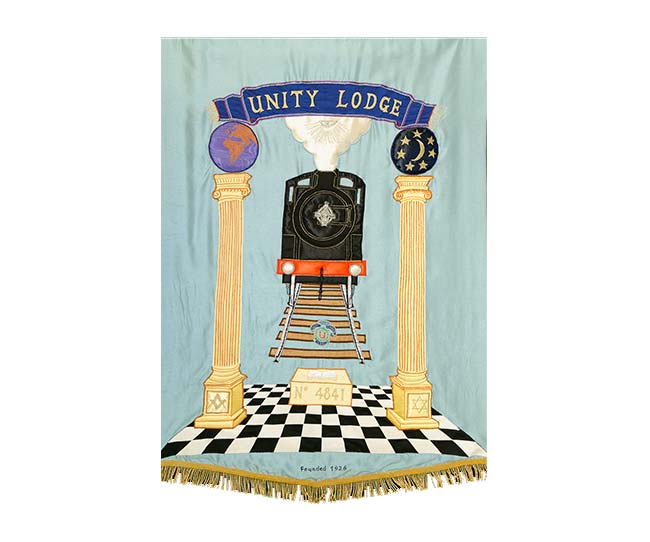
At the first Anniversary Meeting on 14th October 1927 a Banner was presented to Unity Lodge by Bro. J. W. Boxall, Arboretum Lodge No.731. He had personally made the Banner shown at the top of the Back Cover to show in a practical manner his appreciation of the kindness extended to him by the Brethren of Unity Lodge at every meeting he had attended. This warmth of welcome to Visitors has continued over the 75 years of the existence of Unity Lodge.
The Unity Lodge Banner depicts the front elevation of a Midland Railway ‘Compound’ Class 4-P Express Passenger Locomotive with outside cylinders which were introduced in 1924. A famous Midland Railway steam locomotive being built at Derby when Unity Lodge was consecrated was very appropriate for the Banner for a Lodge with many members having previously worked for the old Midland Railway. The front cover shows Class 4-P Locomotive No.’1000’ hauling an Excursion Train. However, these locomotives were numbered from 3835 to 4026 consecutively! So what locomotive Class carried the number ‘4841’given to Unity Lodge by Grand Lodge of England? Locomotive number ‘4841’ belonged to the famous London, Midland & Scottish Railway ‘Black’ Class 5 Mixed Traffic Locomotive built at Crewe Locomotive Works in late 1944. Hence the Lodge Banner was a composite of a real steam locomotive and a number from a locomotive that did not exist at its formation.
There is no record that this Banner was ever dedicated. The Banner was repaired and cleaned during 1975/76 by the wife and daughter of Wor. Bro. W. H.Tunnicliffe for the Lodge Fiftieth Anniversary. However, the Banner was fast approaching the end of its working life although it had been in service longer than the locomotive it was based on.
Second Lodge Banner
In 1990 a modified design was proposed to reflect that the Membership of Unity Lodge was no longer predominantly railway employees. The final Banner layout is shown at the bottom of the Back Cover and was developed by Wor.Bro.B.J.Smith of this Lodge based on an official Midland Railway drawing obtained by Wor. Bro. G.D.Holland, Beaureper Lodge No.787.
The new Banner was scheduled for Dedication by Right Worshipful Provincial Grand Master Sydney Martin Crawshaw Jones on 8th February 1991. However, prolonged heavy rain caused flooding of the driveway to the Masonic Hall necessitating a postponement. The Banner Dedication finally took place on Friday 14th June 1991 and Worshipful Master J.I.Marler gave the Symbolism of the new design..
Hall Stone Jewel
In 1919 The Most Worshipful Grand Master launched the Masonic Million Memorial Fund to build a new Temple and War Memorial in memory of those Brethren who made the supreme sacrifice in the Great War. It was considered that a suitable Headquarters for Grand Lodge in London would their best memorial. A Notice of Motion was given at the Lodge Meeting on 10th December 1926 ‘that Unity Lodge shall qualify as a Hall Stone Lodge in connection with the Masonic Million Memorial Fund’.
The laying of the Foundation Stone of Masonic Peace Memorial (as Freemasons’ Hall was known until the outbreak of the Second World War) took place at The Royal Albert Hall, London on 14th July 1927. The Great Temple and Memorial was opened and dedicated in 1933. At the Regular Meeting on 14th December I928, the Lodge Secretary read a Ietter dated 15th November
1928 from the Grand Secretary acknowledging completion of the Lodge’s
qualification as a Hall Stone Lodge. The Worshipful Master was invested with the Collarette and the Jewel at the Lodge Meeting on 11th January 1929. Sixteen Members of Unity Lodge also qualified for Hall Stone Jewels and these were presented to seven Brethren at the Regular meeting on 14th December 1928 and to the others in due course. At every Installation Meeting the Installing Master invests his successor with the Collarette and Hall Stone Jewel whilst addressing him on the symbolism and significance of the Jewel
The Lodge Circular
The Lodge Circular has had significant changes over the years as can be seen from comparison of the Lodge Circulars shown in Figure 2. The Circular for the Regular Lodge Meeting on 10th December 1926 had only the front view of the Midland Railway ‘Compound’ Class 4-P Passenger Locomotive. These early Circulars contained details of the Lodge Officers for the particular year that either appeared on the third page or on the back page depending on the Lodge Business. The Founders List appeared on the last page of the Consecration Circular but did not appear regularly again until the Circular for the Meeting on 14th December 1928. The Past Masters List also first appeared on the bottom of the third page of this Circular. Multiple ceremonies and ballots were common in these early Lodge Meetings and often there was not enough space on the circular to include the Founders List! The Founder’s List was discontinued after the Meeting on 11th December 1942 leaving a blank last page until replaced on the back page by the Past Masters List which first appeared on the Circular for the Meeting on 9th November 1945. In 1945 Officers appointed and invested at the Installation Ceremony in October were listed on the back page of the November Meeting Circular with the Past Masters list on the back page for the rest of the Masonic Year. This practice continued until 1975 when from the Installation Meeting in that Year all Past Masters (from 1926) were listed but not the Officers. From November 1982 to date the practice is for the Lodge Officers for the particular year together with Past Masters (in smaller print) to be detailed on the back page.
The Lodge Circular for the Meeting on 11th February 1927 carried the following Antient Charge at the top of the inside cover:
Ancient Charge
‘From antient times no Master or Fellow could be absent from his Lodge, especially when warned to appear at it, without incurring a severe censure, unless it appeared to the Master and Wardens that pure necessity hindered him.
Be very cautious whom you recommend for initiation. You have a good Lodge – keep it so, numbers are not always beneficial.’
The inclusion of this Antient Charge was discontinued after the Circular for the Meeting on 11th April 1930 although its sentiments are very true today.
Psalm 133 Verse 1 namely:
“Behold how good and joyful a thing it is for Brethren to dwell together in unity”
first appeared on the Lodge Circular for the Meeting on 13th January 1928 and has appeared on every Lodge Circular since this date. This verse was also the first two lines of the Anthem sung at the Consecration of Unity Lodge. The Hall Stone Jewel first appeared on the Lodge Circular for the Meeting on 14th December 1928 following presentation of the Jewel to Unity Lodge at the Quarterly Communication of Grand Lodge on 5 December 1928. The Lodge Circular for the Installation Meeting in October 1976 first carried the following statement:
‘There is a Royal Arch Chapter attached to this Lodge and all Master
Masons are eligible for membership’
The Circular for the Consecration Meeting on 8th October 1926 stated that Morning Dress had to worn and this continued for all Lodge Meetings until 1950. However, Uniform could to be worn during the War years. The Circular for the Installation Meeting on 13th October 1950 stated ‘ In accordance with the recommendation from Grand Lodge, will Brethren kindly wear dark clothing, black footwear and ties, and white collars’. For the Installation Meeting on 10th October 1952 stated additionally ‘White gloves will also be worn’.
World War Two
Grand Lodge suspended all Masonic meetings following the outbreak of War on 3rd September 1939. Grand Lodge permitted the resumption of meetings at the end of September 1939 and Unity Lodge, as did most Lodges, held Masonic meetings in a somewhat curtailed manner in spite of petrol shortages, blackouts and pressure from war work. It must have very been hazardous for Brethren travelling to and from Unity Lodge Meetings as the use of lights on bikes and cars was banned in early September 1939 in addition to the ‘blackouts’! During this period of National Emergency and stress Freemasonry offered the opportunity for fraternal gatherings and companionship from which so much moral support and comfort was derived. Unity Lodge membership at the outbreak of hostilities was sixty eight and this increased during the War years with fourteen Initiates and three Joining Members as shown in Table 6. There were also eight Passing and eleven Raisings during this period.
Rationing of Clothes, Clothing and Footwear was introduced in June 1945 but tapes, braids ribbons and other fabrics could be bought without coupons if less than 3” in width. Consequently the wearing of gloves for ceremonies was discontinued and it was suggested that 3” instead of 4” ribbon should be used on regalia as an economy measure. Meetings were allowed to continue until 22.00 in the Masonic Hall, Gower Street, Derby from the beginning of February 1940. The Provincial Grand Master suggested lists of Past Masters and Founders should be deleted from the Lodge Circulars to make them smaller and hence save paper. Unity Lodge Circular was consequently reduced to a single sheet.
During these troubled times Unity Lodge continued the charitable work of Freemasonry as typically shown by the donations made in 1940:
Festival of the Royal Masonic Benevolent Institution The Lord Lieutenant (Derbyshire) War Charity to help existing organisations to provide additional comforts to the Forces. Provincial Benevolent and Educational Fund. Royal Masonic Hospital. Treloar’s Cripples Hospital.
Unity Lodge has continued to maintain the principle that the distinguishing characteristic of a Freemason’s heart is Charity. All Unity Lodge Brethren have either Covenants or Gift Aid commitments to ensure the Lodge meets its target towards the Provincial Grand Charity 2003 Appeal for the Masonic Trust for Girls and Boys.
At the outbreak of the Second World War, the London, Midland & Scottish Railway had major responsibilities for the supply and maintenance of essential war supplies and the transportation of war equipment and personnel. Unity Lodge Members had responsible positions in District Controllers and Control Offices, which controlled the movement of trains as shown in Tables 1, 2, 6. Service personnel transportation varied from conveyance of small parties by ordinary passenger trains to the movement of large concentrations requiring 300 special trains. War equipment transportation ranged from single wagons carrying a solitary piece of equipment to as many as fifty trains loaded with tanks and Bren-gun carriers. One Unity Lodge member, who was elected as a Joining Member in 1941, was the Railway Transport Officer, Central Ordnance Depot, Chilwell, Nottingham and held a very responsible position. Most service departments kept their guns, tanks, explosives, bombs, grenades, etc. at Ordnance Depots such as Chilwell. The transfer of war supplies from factories to depots and depots to ports and hence to the front line was fundamental in maintaining the war effort and was largely the responsibility of the London, Midland & Scottish Railway. Railway plans for the evacuation of children, with mother or school officials, commenced on 1st September 1941. London Midland & Scottish Railway handled much of this traffic with a steady flow to the railway stations with 1450 special trains moving some 500,000 passengers within four days.
As the war proceeded the Carriage & Wagon Works at Derby made a major contribution in the supply and maintenance of a wide range of military equipment. Aircraft fuselage sections and ailerons were produced together with complete wings for ‘Hurricane’ and ‘Typhoon’ aircraft. A repair shop for ‘Hampden’ and ‘Lancaster’ bomber fuselages was set up within the Works that also repaired hundreds of aircraft wings. The Works had its own Home Guard Company with responsible for guarding the Works and probably the main railway line adjacent to the Works. Works personnel also took up fire- watching duties following the Fire Prevention (Business Premises) Orders of January and September 1941 which required employees to undertake fire- watching and fire-fighting thus providing additional support to the National Fire Service.
The Royal Masonic Hospital in London was put at the disposition of the War Office in late 1939 for the duration of hostilities. Some 300 beds were available for the treatment of the wounded from the Front, local air raid casualties and those who were suffering from illness as a result of the War. Grand Lodge were legally not allowed to use its ordinary funds for the war effort and in view of substantial expense involved asked Lodges and individuals for donations to express in the name of Freemasonry all the sympathy and gratitude for those actively engaged in the War. Unity Lodge donated five guineas to this War Appeal.
In late August 1940 Grand Lodge suggested that Freemasons would gladly contribute to the country’s urgent war needs by surrendering their Masonic Jewels for melting down. This would ensure a valuable contribution of gold and silver for the national effort. It was suggested that Festival Jewels and those commemorating particular occasions should readily be handed in. However, the decision on Jewels of a more personal nature such as Founders Jewels and Past Masters Jewels was left to the Brethren themselves but Grand Lodge believed that such sacrifices would be gladly made. Unity Lodge responded rapidly to this request and Jewels had been collected and forwarded to Grand Lodge before the Installation Meeting on 11th October 1940. This spontaneous response to the war effort would explain the dearth of Unity Lodge Masonic Jewels especially the Founders Jewel where only three are thought to exist.
A Report on Freemasonry and War as affecting Unity Lodge No.4841 dated 25th January 1947 was forwarded to Grand Lodge in accordance with the instructions contained in Quarterly Communication dated 5th June 1946 (see Table 7). Unity Lodge members held senior positions in the Army, Home Guard, Air Raid Precautions and National Fire Service. It is noted that Bro. Capt. L.J. King was promoted to the Rank of Major for his war services for King and Country. Two Members in the Home Guard were highly decorated for services in connection with War Transport and two Special Constables received Long Service Awards. Lodge Meetings were held without interruption throughout the War Years although the Meetings started three-quarters of an hour early. This enabled Lodge Members living some distance away from the Masonic Hall to catch train and public service vehicles. Although many members of Unity Lodge were actively involved in the war effort, the average attendance at Lodge meetings during the War Years decreased by only three which considering the circumstances was highly commendable. No Lodge Member was killed during the War and there was no loss or damage to Lodge records or property.
Ladies Evening
In 1928 the Lodge Permanent & Selection Committee considered holding a Ladies Evening. However, due to the small membership of the Lodge (which was in fact 58) and because many members lived away from Derby it was not considered further. A Ladies Evening was again proposed in 1945 but due to the prevailing food and petrol rationing it was considered inappropriate to inaugurate such an Evening.
It was not until 1947, that Ladies Evenings were again considered and, after approaches to The Railway Institute and Cattle Market Hotel, it was established:
1) A Dinner, Whist Drive, Dancing and Buffet would mean restricting
the attendance to 100 people and to cover costs a charge of 25/- each, exclusive of alcoholic drinks, which was considered expensive.
2) A Ladies Evening similar to that held by other Derby Lodges in
1947 with Musical Entertainment, Whist Drive, Dancing and Buffet
would require an attendance of at least 150 people each paying 13/- or 10/- if the buffet was not free.
Dancing (or maybe it was the Whist Drive) was obviously exhausting because refreshments were also proposed at 10.30pm including sandwiches, cakes, trifle, ice-cream and tea or coffee. It was recommended that the Ladies Evening should not be held that year since the number of Unity Lodge Brethren with their wives that would attend would only be about 20 couples. Further difficulties would arise because of the withdrawal of the ‘Basic Petrol Ration’ there would be insufficient taxis available for transport.
A Unity Lodge Ladies Evening was first included in the social calendar in
1973 when Wor.Bro.F.W. Tomlinson was Master. These Evenings have become a
Unity Lodge Tradition since that date and provide an opportunity for the Brethren to show their appreciation of the support given by the Ladies. Ladies Evenings not only promote openness by encouraging non-Masons to attend but are also a good opportunity to introduce potential Candidates and their partners to Masons and Masonic Traditions.
Gower Street, Derby
In 1871 Provincial Grand Lodge purchased a plot of land on the corner of Green Lane and Gower Street, Derby on which to build a new Masonic Hall. The Foundation Stone was laid by the Provincial Grand Master The Marquis of Hartington on 18th June 1873 who consecrated and dedicated the new Masonic Hall on 5th November 1873. The Constitution and Consecration of Unity Lodge took place on 8th October 1926 at the Masonic Hall, Gower Street as were all the Lodge’s subsequent Regular Meetings. For many years there were serious complaints about the lack of ventilation in the Dining Room at the Masonic Hall. Early attempts were unsuccessful as none of the experiments removed the tobacco smoke without at the same time either creating draughts or excessive noise from the electric fans.
In the late 1940’s the growth of Freemasonry in Derbyshire necessitated either extending the Gower Street premises or moving to a new site. In 1969 the premises at Gower Street were fully used and no further increase in the number of Meetings was possible or new Lodges consecrated. Lodges of Instruction, held after Regular Meetings, were already using the Temple twice nightly on occasions. A re-development programme proposed by the Church of England affecting the area between Gower Street and St. Peter’s Churchyard accelerated the purchase of a suitable site in or near to the Borough of Derby for a Masonic Hall.
Several sites were considered including Elvaston Castle and Breadsall Mount. The latter is now Breadsall Priory Golf and Country Club whose facilities are regularly used by Members of Unity Lodge and other Derby Lodges! These sites were rejected for various reasons and in 1972 The Grange, Littleover was purchased for £46,000 from Rolls-Royce Ltd. just before the Company went bankrupt. The last Masonic Meeting at the Masonic Hall, Gower Street was held by Unity Lodge No.4841 on Friday 13th October 1972.
The Grange, Littleover, Derby.
This Victorian building in its grounds with ample car parking was furnished and renovated at an additional cost of £75,000 of which the major part was the construction of a new wing to incorporate a new Masonic Temple. The new Temple was consecrated by the Provincial Grand Master on 6th November 1972 and the keystone over the entrance to the Gower Street Temple was incorporated into the new building.
Early in the morning of Sunday 2nd December 1990, smoke and flames were seen billowing from the front of The Grange. Although the Fire Brigade was on the scene quickly, the Provincial Grand Master’s Room, Offices, Storerooms and the Library in the old part of the Building were either severely damaged or destroyed. The beautifully panelled staircase was completely destroyed, as were portraits of Past Provincial Grand Masters dating back over two hundred years, and also showcases containing irreplaceable antiques and memorabilia. Fortunately the Fire Doors were effective in prevented the spread of fire from the old part to the Two Temples and the storeroom containing Lodge Furniture for the forty or more Lodges and side Degrees which then met at The Grange. The two Temples, kitchens and main dining room were functional and no Masonic Meeting was cancelled. Access to the upper floor was by the fire escape with a temporary roof of corrugated iron. The re-building enabled certain alterations to be made including a new reception area, new bar, conversion old bar lounge into a dining room and enlargement of the available floor area. Work commenced in August 1991 and completed in early 1992.
Emergency Lodge Meetings
In 1949 Grand Lodge requested that Unity Lodge Pass and Raise Bro. Charles Douglas Butcher hailing from the Salah-ed Din Lodge No.1071, Acre Palestine since his Lodge in Palestine had been destroyed. Bro. Butcher worked in the Chief Accountants Office, London Midland Railway, Derby and following Dispensations from Provincial Lodge was Passed on 10th September 1948 and Raised 13th May 1949. No supper was provided on either occasion due to the shortness of the Meetings. Bro. Butcher was elected a Joining Member in November 1949 and consequently held various Offices in the Lodge becoming Worshipful Master in 1957 and 1960. Wor. Bro. Butcher later resigned due to ill health and for outstanding service over the years to Unity Lodge was made an Honorary Member in 1975.
Unity Lodge held many Emergency Meetings during 1950/60 due to many candidates being Initiated into Freemasonry. These regular Initiations meant a large number of Brethren were waiting to be Passed and Raised and necessitated three Regular Meetings during 1967/68 being held on a Saturday starting at 2.00 p.m. or 3.00p.m. As a consequence it was proposed at the Regular Meeting on 10th February 1966 that Unity Lodge By-Laws be amended as follows:
1) The Lodge shall meet at the Masonic Hall, Gower Street, Derby on
second Friday in each month from October to June inclusive starting at 6.00pm.
2) The Master and Treasurer shall be elected by ballot and the
Tyler and Charity Representative by a show of hands at the Regular Meeting in June.
Lodge Of Instruction
A Motion of Notice at the Regular Lodge Meeting on 10th December 1926 proposed ‘that a Lodge of Instruction be formed in connection with Unity Lodge‘. The Lodge of Instruction was not held at Masonic Hall, Gower Street which was being fully used with the Temple already being used twice nightly on occasions by Lodges of Instruction following Regular Meetings. In December 1926 Provincial Grand Lodge gave approval for the Lodge of Instruction Meetings to be held at the Midland Hotel, Derby on the First and Third Thursdays of each month except August and September. This venue was ideal as a large number of Unity Lodge Members worked only a few hundred yards from the Midland Hotel and could attend the Lodge of Instruction on the way home. The first Lodge of Instruction was held on 20th January 1927 at 6pm with Wor. Bro. A. B. Maclean as Preceptor.
The Lodge of Instruction was held for some thirty years in the Midland Hotel after which it was held at other venues:
1) At the Regular Lodge Meeting on 9th November 1956 it was proposed
the Lodge of Instruction be held at the York Hotel. Midland Road, Derby in each month except June to September at 5.30p.m. The York Hotel was also very convenient to the Railway Offices being just across the road from the Midland Hotel! The Manager, York Hotel must have been impressed because he was initiated into Unity Lodge in April 1964.
2) At the Regular Meeting on 19th April 1970 it was proposed that the
Lodge of Instruction should meet at the Unitarian Chapel, Friargate, Derby on the first Thursday of each month except June to September at 7p.m.
After the last Lodge Meeting at the Masonic Hall, Gower Street in 1972, the new Lodge of Instruction By-Laws stated ‘the Lodge shall assemble at the Derby Masonic Hall, The Grange, Burton Road on the first Thursday in each month, except June to September, at 7 o’clock in the evening’. It was also stated that ‘These By-Laws shall be read in open Lodge of Instruction once in each year’. The Lodge of Instruction has held a Dinner/Social for Members since 1952 which preceded the Lodge Ladies Evening by some twenty years. The rehearsal of the Opening and Closing of the Lodge in the Three Degrees by the Junior Brethren was introduced in early 1976. It has become a Unity Lodge tradition to hold an extra Lodge of Instruction in June with the Junior Brethren demonstrating either an Initiation or Raising (including the full Traditional History) in full Masonic Regalia. This Meeting enables the Junior Brethren to have early experience of speaking on the floor of the large Temple and is followed by a Buffet Supper with the Ladies.
Unity Lodge has over the years has been fortunate in having a strong Lodge of Instruction that has been well supported by the Past Masters and the Junior Brethren. The enthusiasm and hard work of the Junior Brethren has ensured the high standard of Ritual Working in the Lodge has been maintained over the years. Unity Lodge has been very fortunate in having Preceptors detailed in Table 8 who over the years have unselfishly contributed so much to the development of Freemasonry in Unity Lodge.
Sporting Activities
In the early years there were regular references to cricket matches between Freemasons in the Nottinghamshire and Derbyshire Provinces. Provincial Grand Lodge thanked Unity Lodge for providing a ball at a cost of £1/5/0 for the cricket match played at Chatsworth on 17th July 1929 for which tickets were 6d each admitting Members to the Pavilion and Stand
At the Installation Meeting on 11th October 1935 a letter was read from the Worshipful Master, Harrington Lodge No.5098 regarding an informal meeting to discuss forming the Derbyshire Masonic Golfing Association. On 23rd October 1935 the Masonic Golfing Association was formed with the Deputy Provincial Grand Master Very Wor. Bro. E. C.W.D. Walthall as the first President. Unity Lodge playing an active part with Bro. J. Scragg as the first Assistant Secretary and Bro. M. Bradshaw appointed the Lodge Representative. Major golfing tournaments for trophies, cups, etc. were suspended during the war years but local competitions continued for small prizes. However, Golf Clubs were requested to ensure that ‘players are asked to collect bomb and shell splinters to save these causing damage to mowers’. The Masonic Golfers Association has gone from strength to strength over the years and the Crawshay Jones Golfers’ Lodge No.9476 was consecrated in 1993.
At the Installation Meeting on 8th October 1937 a letter was read from the Worshipful Master, Hartington Lodge No.1085 regarding an informal meeting to discuss forming the Derbyshire Masonic Bowls Association. It is possible that the meeting never materialised, or maybe the Brethren took a long time to decide, but at the Regular Meeting on 10th January 1964 a letter was read from Wor. Bro. F. G.Barnes: Past Master Hartington Lodge No.3430 regarding another informal meeting to discuss forming the Derbyshire Masonic Bowls Association! However, this proposal was abandoned several months later to due lack to lack of support.
Chapter Of Unity No.4841
At the Regular Meeting on 9th January 1927 Wor. Bro, L. F.Rowlandson P.PS.G.D (Cheshire), Immediate Past Master, proposed ‘that steps be taken to form a Royal Arch Chapter in connection with the Unity Lodge and that the consent of the Lodge be given to petition to Supreme Grand Chapter in connection therewith’. The motion was duly seconded and carried unanimously.
Chapter of Unity No.4841 was consecrated on 4th June 1928 a the Masonic Hall, Gower Street, Derby. A large proportion of the members hail from Unity Lodge although membership is open to members of all Craft Lodges
Provincial Grand Lodge
The first Provincial Grand Lodge Meeting after the Consecration of Unity Lodge was held at the Central Hall, Exchange Street, Derby on 19th March
1927 when the first appointment was conferred on a Member of Unity Lodge.
Wor. Bro.S.H. Scholes, Assistant Secretary of Unity Lodge was appointed Provincial Grand Steward and the Lodge purchased a Steward’s Apron and Collar for his use. This regalia is still Lodge property although slightly the worse for wear having been in use or storage since 1927. Unity Lodge contributed the sum of £2/10/0 as its portion of the cost of Tea provided by the Derby Lodges for Members of Provincial Grand Lodge on this occasion.
The Right Worshipful Provincial Grand Master, His Grace the Duke of Devonshire held an Especial Provincial Meeting at the County Assembly Rooms, Market Place, Derby on Wednesday 2nd November 1927. After the meeting the Brethren were invited to form a Procession and accompany the Provincial Grand Master to the Cathedral Church of All Saints to take part in a special Service in connection with the Hallowing of the Diocese and Cathedral. The Brethren were requested to appear in full Masonic costume and that the Members of the various Lodges should be led in the Procession by the Senior Steward bearing the Banner of the Lodge. Derbyshire Freemasons contributed around £1100 to provide the Reredos (a choir screen) and Altar for the Derby Cathedral. Unity Lodge contributed twenty-five guineas towards these costs.
The Deputy Provincial Grand Master Very Wor. Bro. Brigadier General E.C.W.D. Walthall CMG. DSO. P.S.GD with his officers attended Unity Lodge on the 9th March l928. This was to be the first of many visitors of High Rank to grace Unity Lodge and we wish to express our gratitude to them and particularly to Right Worshipful Brother David Charles Law for visits to the Lodge both as Deputy Provincial Grand Master and Provincial Grand Master.
Provincial Grand Lodge has held its Annual Meetings in various locations including the Drill Hall, King’s Hall and during the War Years in the Masonic Hall, Gower Street, Derby. In 1967 the Annual Meeting was first held at the Bemrose School, Uttoxeter Road, Derby and this was the venue for many years. The support that the Derbyshire Masons gave (and continue to give) the Provincial Grand Master necessitated a venue change and for last few years the Meetings have been held in April at the Derby Assembly Rooms.
Third Annual Festival of The Grand Charity
The Grand Charity was established in 1981 with the objective of providing a registered Charity more outward looking than other Masonic Charities. It would be flexible to respond quickly to urgent need such as a natural disaster while continuing to help individual Freemasons or their dependants who are in distress. The policy of the Grand Charity is to assist petitioners in distressed circumstances, support other Masonic Charities and give donations to non-Masonic Charities.
In 1988 the Province of Derbyshire hosted the Annual Festival for the Grand Charity at the Pavilion Gardens, Buxton. A target of £500,00 was set in
1978 but the Province raised the magnificent total of £1,344, 663.99 with
Unity Lodge contributing the sum of £16,355.94. The Festival was attended by 960 with Freemasons in full Masonic regalia and accompanied by their ladies. Unity Lodge was represented by the Worshipful Master Wor. Bro. T. H. Hill supported by twenty-seven Brethren from the Lodge accompanied by their Ladies. The formal proceedings were then followed by an excellent Banquet. The evening was concluded with a Brass Band Concert on the Terrace followed by a magnificent firework display in the Pavilion Gardens. The moving finale was the Brethren and their ladies singing ‘Happy have we met’. The Festivities were completed with a festival cricket match held by the Derbyshire Masonic Cricket Association between teams from the North and the South of the Province on the Cricket Ground at Chatsworth Park.
275th Anniversary of the Formation of Grand Lodge
On 24th June 1717 four London Lodges came together at the Goose & Gridiron Tavern, St. Paul’s Churchyard and declared themselves to be a Grand Lodge, the first in the world. The Province celebrated this Anniversary with an Evensong in Derby Cathedral on Wednesday 24th June 1992 at 18.30. Unity Lodge Brethren, together with their wives and families, supported the Provincial Grand Master on this momentous occasion.
Grand Charity Festival in 2003.
The present charitable focus within the Province is a Festival to support the Masonic Trust for Girls and Boys culminating in May 2003. The target is a sum of one million pounds and the Grand Charity Festival will again be held at Pavilion Gardens, Buxton on Thursday 22nd May 2003 under the Presidency of the Provincial Grand Master Right Worshipful Brother David Charles Law. The President and Secretary of the Masonic Trust for Girls and Boys will attend together with other members of the Board and United Grand Lodge. As previously stated all Unity Lodge Brethren have either Covenants or Gift Aid commitments to assist the Charity Steward in ensuring the Lodge meets its target towards the Provincial Grand Charity Appeal.
Grand Lodge
The Grand Master is empowered to confer the rank of Past Grand Officer on any Brother of ability who has been regularly and installed as a Master of a Lodge under the Grand Lodge. Wor.Bro.L.F.Rowlandson was already a Past Grand Standard Bearer (and Grand Lodge ranks are denoted in bold letters and abbreviated such as P.G.Std.B) when installed as the First Master of Unity Lodge in 1926.
Since its Consecration in 1926 several Unity Lodge Members have had Grand Lodge Honours bestowed on them as shown in Table3. The first appointment of a Brother who was initiated into Unity Lodge was to Wor.Bro.C.S.Snell who was conferred the rank of Past Grand Standard Bearer (P.G.Std.B). It was a further twenty years before Wor.Bro.J. Beal was appointed Past Assistant Grand Director of Ceremonies (P.A.G.D.C) in 1980 after a distinguished Masonic career, namely Worshipful Master in 1956, Lodge Secretary from 1959 to 1981 and Provincial Assistant Grand Secretary from
1972 to 1984. The latest recipient of Grand Lodge Honours was Wor. Bro.H.H.
Barker P.Prov.J.G.W who was appointed P.A.G.D.C. in 1993 and was Worshipful Master in 1975, Lodge Secretary from 1981 to 1988 and Provincial Junior Grand Deacon in 1987.
At the Regular meeting on 10th April 1963 the Brethren were informed that amongst the Masonic effects of the late Wor, Bro. Kain was a letter addressed to him by Bro. Major Williams, Superintendent of Buckingham Palace dated 4th July 1947. The letter referred to a conversation between Wor. Bro. Kain and His Majesty George VI on the morning after the King’s installation as Grand Master.
Provincial Grand Lodge
Provincial Grand Lodge Honours are bestowed on Brethren at the discretion of the Provincial Grand Master of Derbyshire at the Provincial Grand Lodge Meeting in April which for the last few years has been held at the Derby Assembly Rooms. These honours are normally bestowed on Masters seven years after being in the Chair either as an Acting Officer or more frequently as a Past Provincial Rank. Master Masons can be bestowed these honours for outstanding service to the Province.
Since its Consecration in 1926 Unity Lodge Members have held various acting offices including Provincial Grand Treasurer (Prov.G.Treas.), Provincial Grand Registrar (Prov.G.Reg), Provincial Grand Pursuivant (Prov.G.Pursvt) and Provincial Grand Steward (Prov.G.Stwd). Wor. Bro.C.S. Elder was appointed Provincial Grand Steward on 6th December 1975 and was wearing this regalia during the year of the Fiftieth Anniversary of Unity Lodge. The only occasion to date that a Member of Unity Lodge has been appointed to the acting rank of Provincial Grand Warden was when Wor.Bro.W.L. Phillips was appointed Provincial Senior Grand Warden in 1998. Past Provincial Honours together with Acting Offices bestowed on Members of Unity Lodge are shown in Table 3. The Lodge remembers with sadness those Past Masters who passed to the Grand Lodge Above before receiving Provincial Grand Lodge Honours namely Wor.Bros. C.J. Jennings, C.G.Williams and D.M. Fish.
Non Masonic Honours
Two Members in the Home Guard were highly decorated for services in connection with War Transport and two Special Constables received Long Service Awards as shown in Table 6.
Bro. H.D. Hall was initiated into Unity Lodge on 14th April 1961 whilst serving in the Royal Air Force as a Squadron Leader at R.A.F Gaydon, Warwickshire. Bro. Hall was an infrequent visitor to Unity Lodge due entirely to a very distinguished Air Force service career. He was promoted to Air Vice-Marshall on returning from Malta on expiration of the Anglo- Maltese Defence Agreement on 31st March 1979 where he was the last Senior Officer in charge of British Forces in Malta. Bro.Hall in late 1979 was seconded to the British High Commission in Canberra, Australia and corresponded for some years with the then Secretary. He resigned in 1993 following a decision to settle in Sydney, Australia where he still lives. Bro.Hall’s uniform, photographs and other items are displayed in the War Museum in Malta.
Honorary Members
The original Lodge By-Laws stated that Honorary Members shall be Brethren whom the Lodge may, by ballot or vote, confer that distinction as a mark of respect, and in consideration of services rendered to Unity Lodge. This Honour was first bestowed on two Brethren who were Consecrating Officers at the Constitution and Consecration of Unity Lodge on 8th October 1926 (see Circular inside Front Cover) namely:
1) Wor. Bro. Joseph Cook P.P.S.G.W, P.A.G.D. C.(Eng).
2) Wor. Bro.Lt.-Col. G. A. Lewis P.P.S.G.W., Provincial Grand Director of
Ceremomies
These Brothers were keenly interested in the progress of Unity Lodge and a vote on 11th November 1927 was carried unanimously. Over the years several Past Masters of Unity Lodge unfortunately have had to resign due to ill health but were made Honorary Members for outstanding service over the years to Unity Lodge as shown in Figure 9.
The first recorded visit of Wor. Bro Ernest Haddon to Unity Lodge was on 8th April 1960 and has been a regular and most welcome visitor ever since This distinguished Brother was made an Honorary Member of Unity Lodge in
1995 in recognition of the support over thirty five years. Wor. Bro. Haddon
was initiated into Jesmond Lodge No.4285 on 16th July 1928 and his 70th Anniversary in Freemasonry was celebrated at Burlingon Lodge No.6736. This unique occasion was attended by 171 Brethren headed by The Right Worshipful Deputy Grand Master Iain Ross Bryce together with the Right Worshipful Provincial Grand Master, Deputy Provincial Grand Master and Assistant Provincial Grand Masters.
Railways Decline In Derby But Not Freemasonry
It has already been stated that Unity Lodge has its origins due to the re -location of Brethren to the General Superintendent’s Department in Derby from London and other amalgamated railways railway operating centres. It is ironic that the start of the decline of Derby as a railway centre was also probably due to the large General Superintendent’s Department being disbanded and re-located following the opening of the new London, Midland & Scottish Headquarters at Euston House, London.
The further decline of the railways in Derby can be summarised as follows:
1) The Chief Mechanical Engineers Department had several reorganisations
and name changes within British Railways. As British Rail Workshops there was a major reorganisation during the sixties resulting in a staff reduction of some 40% with the closure of various sites. During
1968 the Workshops was trading under the name British Rail Engineering
Ltd. (BREL) with Headquarters in Derby and with the Carriage & Wagon Works being the principal construction and maintenance facility. In the 1980’s all BREL Manufacturing Workshops namely Crewe, York and the two Derby Works were sold to the private sector. In 1923 Derby Locomotive Works employed some 4,000 men but the end of the steam age saw its decline as a locomotive manufacturing facility. Although the Locomotive Works had become a thriving maintenance repair centre its workload greatly reduced during the BREL era and the works finally closed in the early 1990’s. The Carriage & Wagon Works employed some 3,450 men in 1923 but this has declined to about 1000 employees today.
2) The Railway Technical Centre, London Road, Derby was officially opened
on 14th May 1964 and at its peak in the 1970’s employed some two thousand people involved in Research, Mechanical & Electrical Engineering and Purchasing. Since1990’s the lack of investment together with extensive privatisation of the railway technical support groups on the site has resulted only a few hundred employees remaining.
This massive decline in the railways in Derby had a direct effect on potential candidates for Unity Lodge although railway employees were regularly Initiated and Elected as Joining Members.
However, in 1957 it was decided that Unity Lodge should widen the scope of initiates and members by considering individuals from other walks of life other than the railways. This decision was immediately actioned as in 1957 there were two Initiations with one candidate employed in an Iron Works and the other a Pilot Officer with the Royal Air Force. However it was not until after 1959 that Candidates and Joining Members from other employers than the railways were regularly Initiated or Elected into Unity Lodge. Since 1967 Unity Lodge has Initiated an unusually high number of ten ‘Lewises’ (defined as the son of a Mason) as shown in Table 10. This included three generations from one family and where possible the Candidate’s Father took the Master’s Chair. Although a Lewis is entitled to be Initiated before any other applicants this right has never been claimed in Unity Lodge. Thirteen of these Brethren are present Members of Unity Lodge. The wide spectrum of industries now represented in Unity Lodge is clearly shown in Table 11 that details the present Members of Unity Lodge. One of these Brethren used his professional talents to ‘moonlight’ as a ‘Bookies Runner’ at the long gone Greyhound Stadium in Vernon Street, Derby!
Lectures
During the 1970/1980’s three Candidates were Initiated each year and during these years it was the tendency for all the Unity Lodge Officers to progress. Hence, each year every Lodge Officer only rose one rung up the Masonic ladder and only one new Officer appointed. At one time there were nine Brethren waiting for their first appointment although the number of Stewards had been increased to ten. The Lodge Committee reluctantly agreed to reduce the Candidates to two per annum. This gave rise to an unallocated Evening in the Lodge Calendar and it was decided that the Junior Brethren would give Sections of ‘The Lectures of the Three Degrees in Craft Masonry’. These were first introduced at the Lodge Meeting on 11th January
1986 when three Past Masters were assisted by the Junior Brethren to work
Sections 1, 2, 3 of the First Lecture. These Lectures have become a Tradition of Unity Lodge and are now held in January or February each year enabling Junior Brethren to have early experience of speaking on the Lodge floor.
Tracing Boards
An explanation of the First DegreeTracing Board was first given by Wor.Bro.J R. Kemp at the Lodge Meeting on 12th June 1981 and who continued to give superb renditions (and sometimes together with the Second Degree Tracing Board at the same Meeting!) until 1996. Since 1997 Wor Bro. T.H. Hill has delivered the First Degree Tracing Board at the June Meeting.
In the early 1980’s the explanation of the First Degree Tracing Board was not given every year due to the large number of Candidates joining Unity Lodge necessitating either Initiation or Passing Ceremonies in June. In the late 1980’s due to a shortage of Candidates there was a trend to have Papers of Masonic interest including:
An Interpretation of The Masonic Apron by Wor.Bro.B.H.Kniveton
‘Freemasonry in South Africa’ by Wor. Bro. T.H.Hill
‘The Great Architect of The Universe’ by Wor.Bro.T.H.Hill
‘An Account of H.M. Habibullah Khan, Emir of Afghanistan Admission into Freemasonry’ read by Wor.Bro.W.L.Phillips
‘Evolution & Development of English Freemasonry by Wor.Bro.D.C.Dobson (Warks) P.A.G.D.C
The Second Degree Tracing Board was first delivered by Wor.Bro.G.Farmer at the June Meeting in 1986 and continued until his passing to the Grand Lodge Above in December 1989. In June 1992 this Tracing Board was partly presented by Bro. H. A. Wibberley, Master Mason but since 1997 Wor Bro. B.H. Kniveton has continued this fine tradition alone. The explanations of the Tracing Boards has become a Tradition of the Unity Lodge Meeting in June together with the elections for Worshipful Master and Treasurer for the ensuing year.
Gifts to The Lodge
The early furnishings of the Lodge are only alluded to briefly although Wor.Bro.L.F. Rowlandson, First Master of Unity Lodge presented the Lodge with a set of Square and Compasses. Over the years other Brethren have given furnishings to the Lodge and their generosity has much appreciated:
Gavels and Blocks from Wor.Bro.G.H.Payne
Wardens Columns from Wor. Bro.K.Slater
Square and Compasses from Wor.Bro.H.H.Barker (These replaced lost items initially presented by Wor.Bro.L.F. Rowlandson)
Tyler and Inner Guard Swords from Wor.Bro.K.Slater
Towards The Century
Unity Lodge had its origins seventy five years ago when the Founders resolved to form a new Lodge in Derby for employees of the London, Midland & Scottish Railway. Although over the years the railway industry in Derby has been decimated beyond recognisation, Unity Lodge has flourished and been strengthened in having a broader based membership. It has not been possible to record the individual contributions of our worthy predecessors who so unselfishly contributed much to establish the traditions and working practices of this fine and proud Lodge. However their strict adherence to Masonic Line and Rule built a sound structure which has stood the test of time and which we in turn should strive to hand down improved and polished by our own Working Tools. This will ensure that Brethren will commemorate the Centenary of Unity Lodge No.4841 and truly say ‘Behold how good and joyful a thing it is for the Brethren to dwell together in Unity’.
Bibliography
1. ‘Unity Lodge. No.4841 50th Anniversary 1926 – 1976’ by Wor.Bro.B.H.Kniveton 2. ‘A Bicentenary History of the Provincial Grand Lodge of Derbyshire 1789-1989’ by Wor. Bro. B.H.Kniveton 3. ‘A Century of Progress – Derby Carriage and Wagon Works’ by J.B.Radford 4. ‘The LMS at War’ by G.C.Nash 5. ‘Derby Works and Midland Locomotives’ by J.B.Radford 6. “Complete List of Locomotives Built at Derby Locomotive Works” by J.B.Radford 7. “Serendipity” Page 38 ‘Railway Lodges’ by Henry Mendoza
Copyright and use
© Unity Lodge No. 4841. All rights reserved.
The 75-year and centenary histories of Unity Lodge No. 4841 are credited to W Bro David Michael Bishop - PProvJGW (Derbys.). This material is provided for reference and review. Please do not reproduce or republish it without permission from Unity Lodge.